
The last time enterprise social boomed, the promises were grand: demolish silos, democratize voices, accelerate innovation. The reality for many companies was very different – fragmentation, adoption fatigue, and analytics that didn’t help you decide anything.
Pearson, the world’s lifelong learning company with over 18,000 employees, have lived both sides. Their first-generation social network ballooned to 1.3 million pieces of content – and they did the unthinkable: they let it burn and started again.
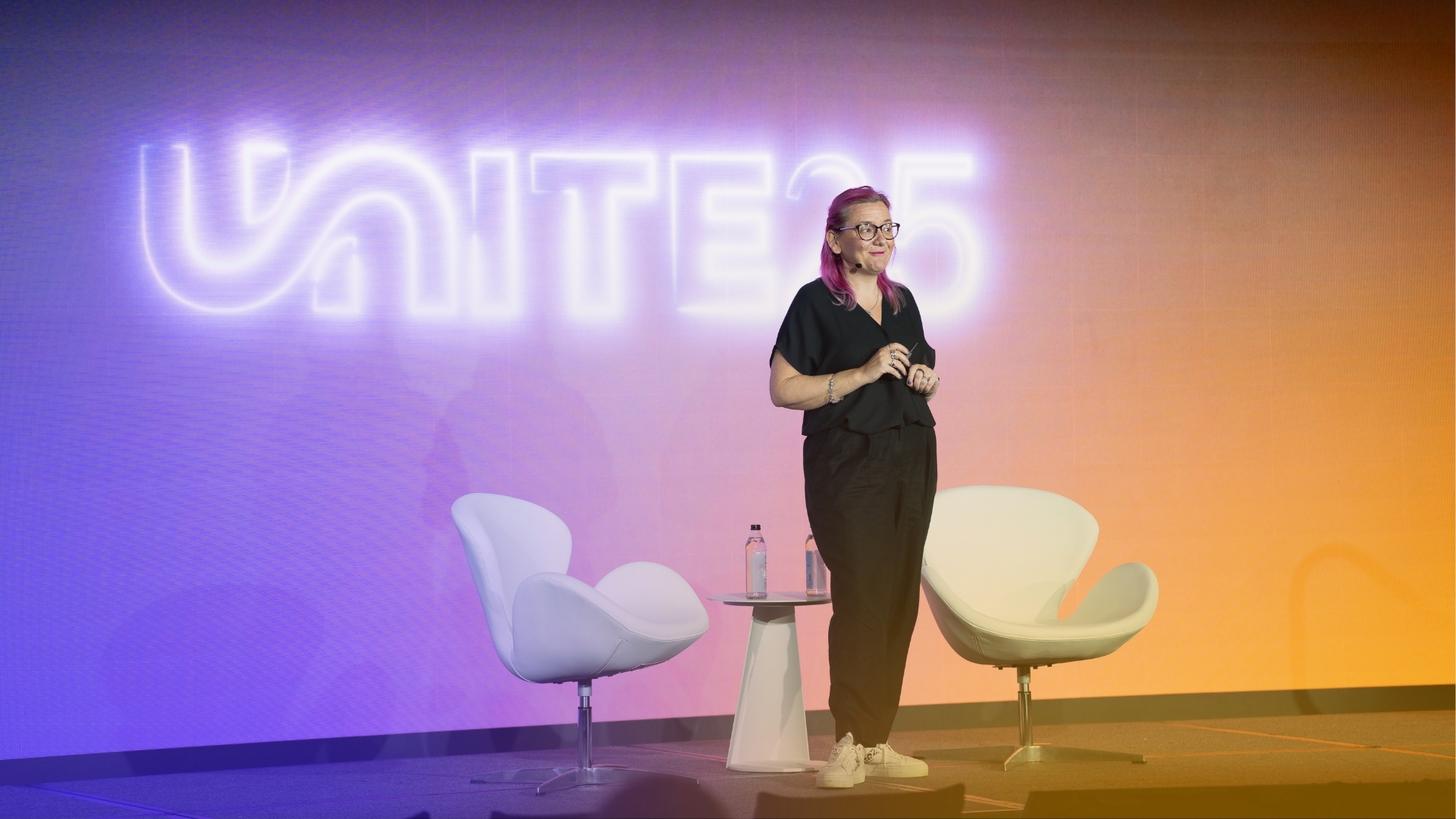
At Unite 25, Kim England, VP of Digital Employee Experience and Community at Pearson, shared the messy middle. This was the real-world journey of how an enterprise found its footing to deliver impact through enterprise social.
Here are a five of the takeaways for communications and employee experience leaders.
Pearson’s enterprise social playbook: five key lessons
1) Governance is not control – it’s credibility
Pearson’s first lesson is that governance is a trust-building mechanism, not a constraint. Kim described how they moved from a low-governance, high-noise model to a disciplined editorial process that ensures only valuable and accurate content remains live.
“News older than 12 months gets reviewed – and if it’s no longer relevant, it’s retired. We don’t ask permission anymore. That was the mistake that led to 1.3 million pieces of content.”
Other key measures includes
- Annual bottom-up pruning: killing low/no-view pages and optimizing the top performing ones.
- Trained creators and an editorial calendar focused on quality and accessibility.
This was a powerful reminder to the audience that governance isn’t red tape; it’s reputation management. In an age of information overload, it’s the discipline that earns credibility.
2) Quality over quantity (and the power of a persona)
As Pearson rebuilt, they shifted from chasing clicks to crafting meaning. A central tool in that shift was the creation of a persona – “Sarah from Texas” – who represents their average employee. Every piece of content is filtered through her lens: why does Sarah need to know this?”
If the answer is “she doesn’t,” the message either moves to a different channel or isn’t used.
This discipline has helped Pearson’s internal communicators focus on relevance, storytelling, and connection rather than volume. Instead of broadcasting everything, they prioritize content that helps employees and connects them to the company purpose and strategy.
3) Enterprise social isn’t dead – it’s grown up
Pearson made waves when they turned off social features on their internal platform. The reason? Too much noise and too little alignment. But when they reintroduced social, they didn’t open the floodgates – they ensured there was a clear purpose and strong community management.
“When we turned social back on, it was silence. It felt like 2010 again. But we have to build that trust back up with our employees. We have to create that safe space.”
Kim’s insight echoes a broader trend: after years of digital saturation and even elements of toxicity, employees are cautious about public posting. It’s no longer about chasing likes – it’s about creating meaningful micro-communities where people can learn, collaborate, and share safely.
This is the new, mature evolution of enterprise social.
4) Always ask: What business problem are we solving?
Kim explained how this question reframes every conversation, enabling her to shift away from talking about technology, to solving business challenges. It’s how Pearson kept the team focused on a single OKR: improving engagement by 10–15%.
“Every decision we make is tested against this objective. And if we don't think it's going to move the needle, then we don't do it – simple.”
For EX leaders, this mindset can be liberating. It means you can stop trying to do everything, and instead do fewer things that matter more. It also gives teams a clear filter for decision-making, helping them communicate with the C-suite in the language of business outcomes, not internal comms jargon.
5) Personalize or perish
This was one of Kim’s "big bets" for the future of employee experience.
Pearson prioritizes personalized, audience-based experiences – especially for managers – paired with clear messaging and channel discipline. Targeting is essential.
“Employees’ time is precious and they don't have time to wade through emails and notifications and the pages on your platform. They want tailored, relevant, just in time content.”
A good starting point is to identify your top three audiences (e.g. managers, new joiners, individual contributors). Build tailored content streams for each, and use data and pop-ups to deliver what they need, when they need it.
Three moves to make now
Kim finished with an impassioned call for EX leaders to take three key immediate steps. These were:
- Audit your platform. Unpublish aggressively; you can always restore. Cleaner catalogs improve the search experience – and employee trust.
- Pilot pop-ups for just-in-time comms. Use segmentation to reach specific audiences through audience targeting.
- Embrace AI – with structure. Experiment with tools and then build a plan for how your team can bring value to the business
The line to remember
“Your employees don’t owe you their attention. You have to earn it.”
Pearson’s journey shows how to earn it: govern bravely, measure what matters, and personalize the experience.
It’s also about recognizing that comms discipline is a prerequisite to employee trust. If they can’t find what matters – or don’t know what matters – technology alone won’t help.
That’s how you move from chasing likes to creating lasting, measurable impact.
Get started. Get your personalized demo.
