
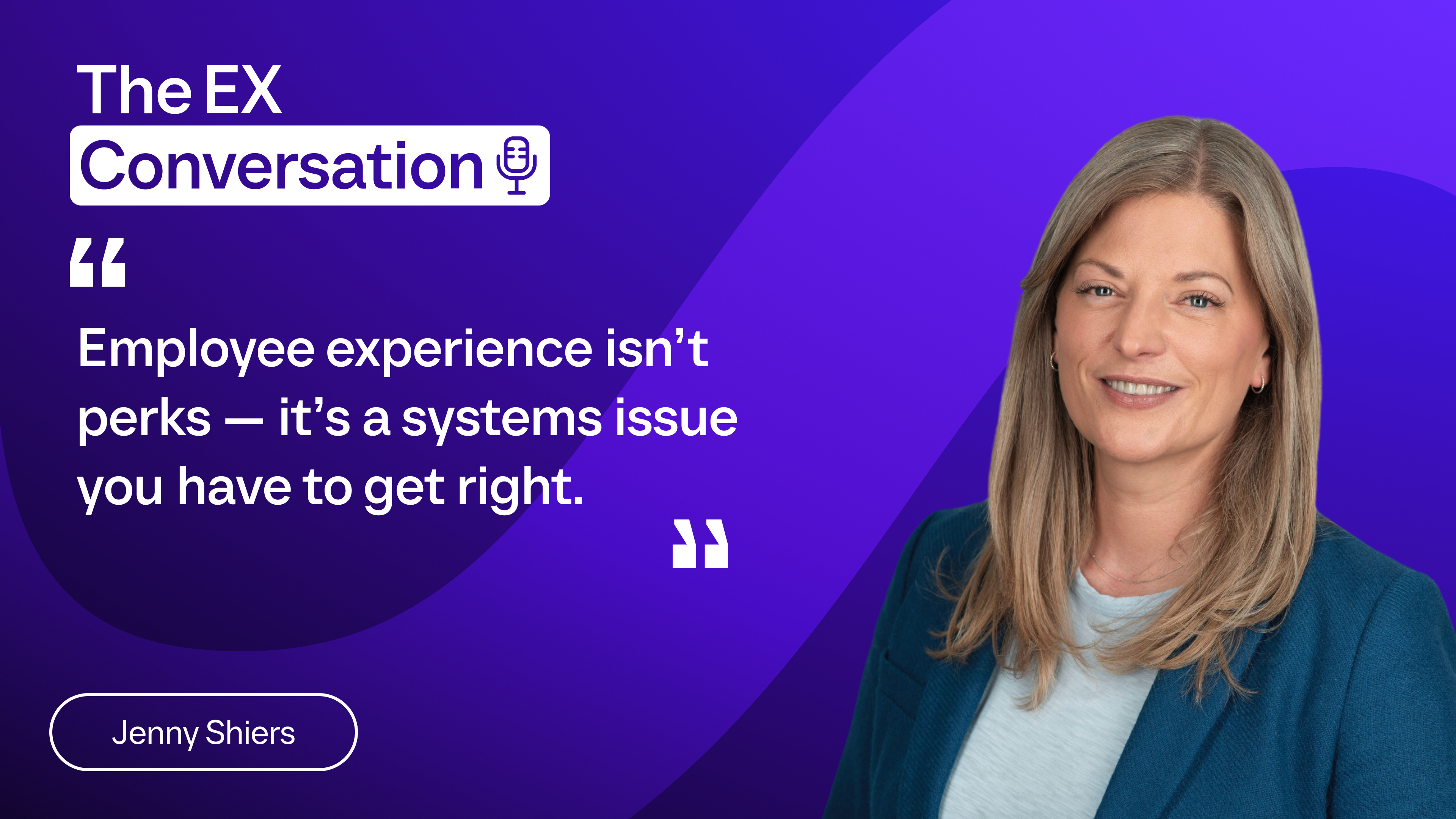
In the first episode of The EX Conversation, Jenny Shiers, Chief People Officer at Unily, shared how she thinks about these challenges in practice. Drawing on her background as an employment lawyer and her time at Salesforce, Jenny offers a grounded, experience-led perspective on what actually helps EX leaders move forward.
Rather than big frameworks or shiny initiatives, her insights centre on alignment, judgment, and realism. The fundamentals that help reduce workplace friction and improve how work actually happen.
Below are three takeaways that will feel familiar and useful to anyone working at the sharp end of EX today.
1. Employee experience isn’t about perks — it’s a system you have to keep tuning
The problem EX leaders recognize:
Employee experience is still too often framed as surface-level extras. Benefits, perks, and engagement activities get attention, while the harder, structural work underneath gets less airtime—partly because it’s harder to explain and measure.
Jenny is clear about the risk of that framing. As she puts it:
"I think a lot of people can think about it as perks… but I think it’s important for companies really to think about employee engagement almost as a systems issue that they really need to get right.”
In practice, this means treating EX as something embedded across how the organisation operates—how decisions are made, how priorities are set, how managers are supported, not a shiny afterthought. The challenge, she acknowledges, is that this work is intangible and iterative. You often don’t know if you’ve “got it right” until you live with it for a while.
For EX leaders, this is a useful reframing. If experience is a system, progress won’t come from one-off fixes. It comes from steady adjustments, clarity, and a willingness to keep iterating even when the results aren’t immediately obvious.
2. Alignment matters more than motivation — especially when priorities keep changing
The problem EX leaders recognize:
Employees want to do good work, but many struggle to see how their day-to-day effort connects to shifting business goals. When strategies change every six or twelve months, alignment can quickly erode.
Jenny describes this as one of the most important—and most overlooked levers in EX.
“This is one of the most important things that businesses can do: helping employees figure out how their role contributes to the overall business objectives.”
At Unily, this thinking shows up in a structured but transparent approach to cascading goals. Leadership sets clear direction, then each level of the organisation translates that into its own priorities, creating a visible line of sight from individual roles all the way to the CEO. That clarity reduces friction, improves collaboration, and helps employees focus their effort where it matters most.
What’s notable isn’t the process itself, but the intent behind it. The goal is not control, but clarity. When people can see how their work fits, they’re better able to make decisions, collaborate across teams, and stay engaged even as the organisation evolves.
For EX leaders, this is a reminder that engagement often follows understanding. Without alignment, motivation alone isn’t enough.
Episode 1: Behind the Curtain of Employee Experience Leadership

3. Data helps, but judgment still does the heavy lifting
EX teams are swimming in data—surveys, scores, dashboards—but still struggle to turn insight into action. Annual or biannual engagement surveys promise clarity, yet often leave leaders unsure what to do next.
Jenny is refreshingly candid about this tension.
“I don’t think I’ve ever quite got [employee surveys] right… you get the information and then nobody really knows what to do with it.”
She points to several structural issues: surveys are infrequent, results shift slowly, and cultural or regional differences can distort scores. Chasing percentage-point improvements can become a distraction from the real work of understanding trends and making thoughtful changes.
Her broader point is about balance. Data is valuable, but it can’t replace leadership judgment. EX leaders still need to interpret context, decide what matters most, and accept that not everything meaningful can be precisely measured.
This mindset also shows up in how she makes decisions personally—using instinct to form an initial view, then asking data to test and support it. For senior leaders, that combination is often more realistic than waiting for certainty that never comes.
Why this matters
Taken together, these insights offer a more sustainable way to think about employee experience. They help EX leaders move forward without perfect data, ground conversations in business reality, and focus energy where it can actually make a difference.
Instead of chasing quick wins or definitive answers, Jenny’s approach encourages clarity, alignment, and informed judgment. It’s a reminder that good EX leadership is less about having all the answers and more about creating the conditions where people can do their best work—even as things keep changing.
Want the full conversation?
If these ideas resonated, the full episode of The EX Conversation goes deeper into Jenny’s thinking, including enablement, learning, and how EX leaders can stay credible with senior stakeholders. It’s well worth a listen for the nuance and lived experience behind these takeaways.
Get started. Get your personalized demo.