
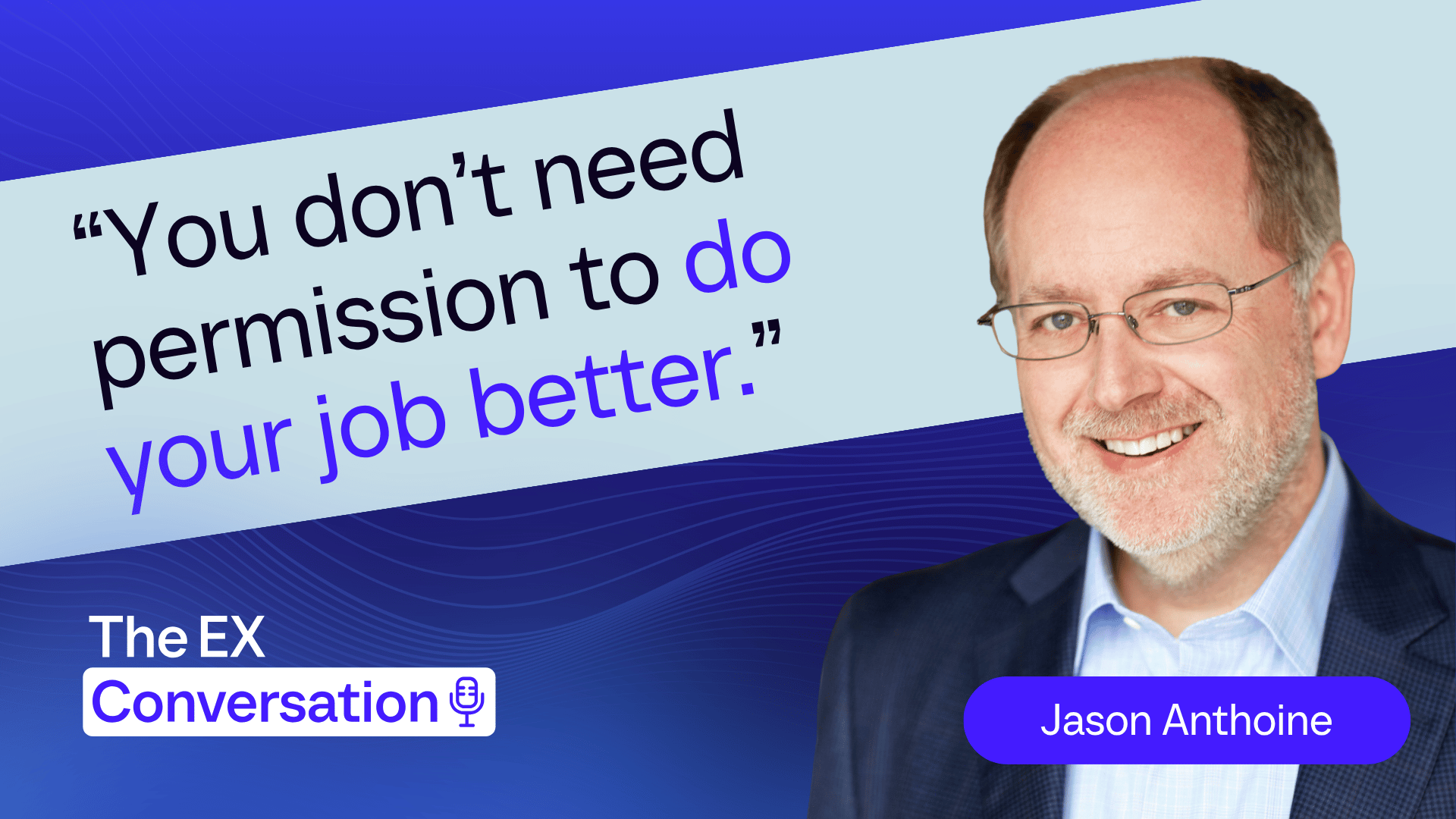
In a recent episode of The EX Conversation, Jason Anthoine—Founder of Arketi Inside and a 30+ year veteran of internal communications, culture change, and employee experience—offers a grounded take on why progress so often stalls. His perspective isn’t about new tools or frameworks, but about what actually moves the needle in practice.
Below are three takeaways EX leaders can learn from his experience.
1. More data isn’t the problem—acting on it is
Most EX leaders are not short of feedback. Engagement surveys, pulse checks, and dashboards create a steady stream of insight. The challenge is what happens next—or, more often, what doesn’t.
As Jason puts it:
“We ask the questions, they’ve given us clear answers… And then the leaders look at that… and they don’t do A, B or C.”
This is a familiar frustration. Employees are asked for input, they provide it, and then they see little change. Over time, that erodes trust faster than no survey at all.
Jason’s perspective is blunt: this isn’t a tooling issue, or even a resource issue. It’s a decision-making issue. Leaders hesitate to act because acting requires admitting that something isn’t working—and that’s where progress stalls.
In practice, he reframes the role of EX leaders here. It’s not to collect better data, but to create the conditions where leaders can act on it. That might mean simplifying choices, translating feedback into business impact, or pushing for fewer, clearer priorities instead of long lists of actions.
The bottleneck isn’t insight—it’s the willingness to move on it.
2. EX doesn’t lack impact—it lacks the language leaders use
Internal communicators and EX teams have always influenced outcomes like performance, retention, and culture. But historically, they haven’t framed that work in a way leadership consistently understands.
Jason puts it simply:
“We do the exact same thing… but we’ve never talked about it using the leader’s language.”
That language, in his view, comes down to three things: driving revenue, controlling costs, and mitigating risk. Marketing functions have long anchored their work here—which is why they’ve earned investment and attention. EX is now catching up.
What’s changing is less about capability and more about positioning. When employee experience work is clearly tied to these outcomes, it becomes easier to justify, easier to measure, and harder to ignore.
Jason sees this shift playing out as internal comms, HR, and marketing become more connected:
“There really isn’t any separation anymore between what a company says in the marketplace and who they are in the workplace.”
In practice, this means EX leaders need to translate their work into outcomes that matter at the executive level—and do it consistently. Not as a one-off exercise, but as a core part of how the function operates.
Episode 16: Why courage is the missing piece in employee experience with Jason Anthoine

3. The real constraint isn’t skill, budget, or tools—it’s courage
Across the conversation, one theme comes up again and again: the thing holding EX back isn’t capability. It’s courage.
Jason is clear on this:
“The bottleneck… I don’t think it’s skill sets… I don’t know that it’s platforms… to me it comes down to courage.”
That shows up in multiple ways. Communicators hesitate to challenge senior leaders, even when something clearly isn’t working. Leaders avoid tough conversations or delay decisions, even when the path forward is obvious.
It also shows up in smaller, everyday moments—like choosing who should lead a town hall.
“Leader B… she’s really strong. It’d be great if we could have her instead… Say that. You have to say that.”
For Jason, courage is what cuts through groupthink, politics, and inertia. It’s what enables people to name issues clearly, push for better decisions, and change direction when needed.
Importantly, he also sees courage as contagious:
“The more courage you demonstrate, the more courage you will see in others.”
In practice, that means EX leaders don’t need to wait for permission to improve things. They can model the behavior they want to see—honest conversations, clear recommendations, and a willingness to challenge constructively.
Why this matters
Taken together, these three ideas point to a different way of thinking about progress in EX.
First, it reinforces that waiting for perfect data is a trap. Most organizations already know enough to act—they just need to move.
Second, it highlights the importance of translation. When EX work is framed in terms of revenue, cost, and risk, it becomes easier to align with leadership priorities and gain traction.
But most importantly, it reframes the role of the EX leader. Progress isn’t just about building better strategies or deploying better tools. It’s about enabling better decisions—often in imperfect conditions.
That means having the confidence to push where needed, the patience to bring people along, and the courage to say what others won’t.
For leaders navigating complex, fast-moving organizations, that’s often what makes the difference between insight and action.
Want the full conversation?
This episode of The EX Conversation surfaces a perspective many experienced EX leaders will recognise—but don’t always articulate this directly.
If this resonated, it’s worth going deeper into the full discussion for the nuance behind these ideas—especially around leadership behaviour, culture change, and how EX teams can influence decisions in practice.
Get started. Get your personalized demo.