
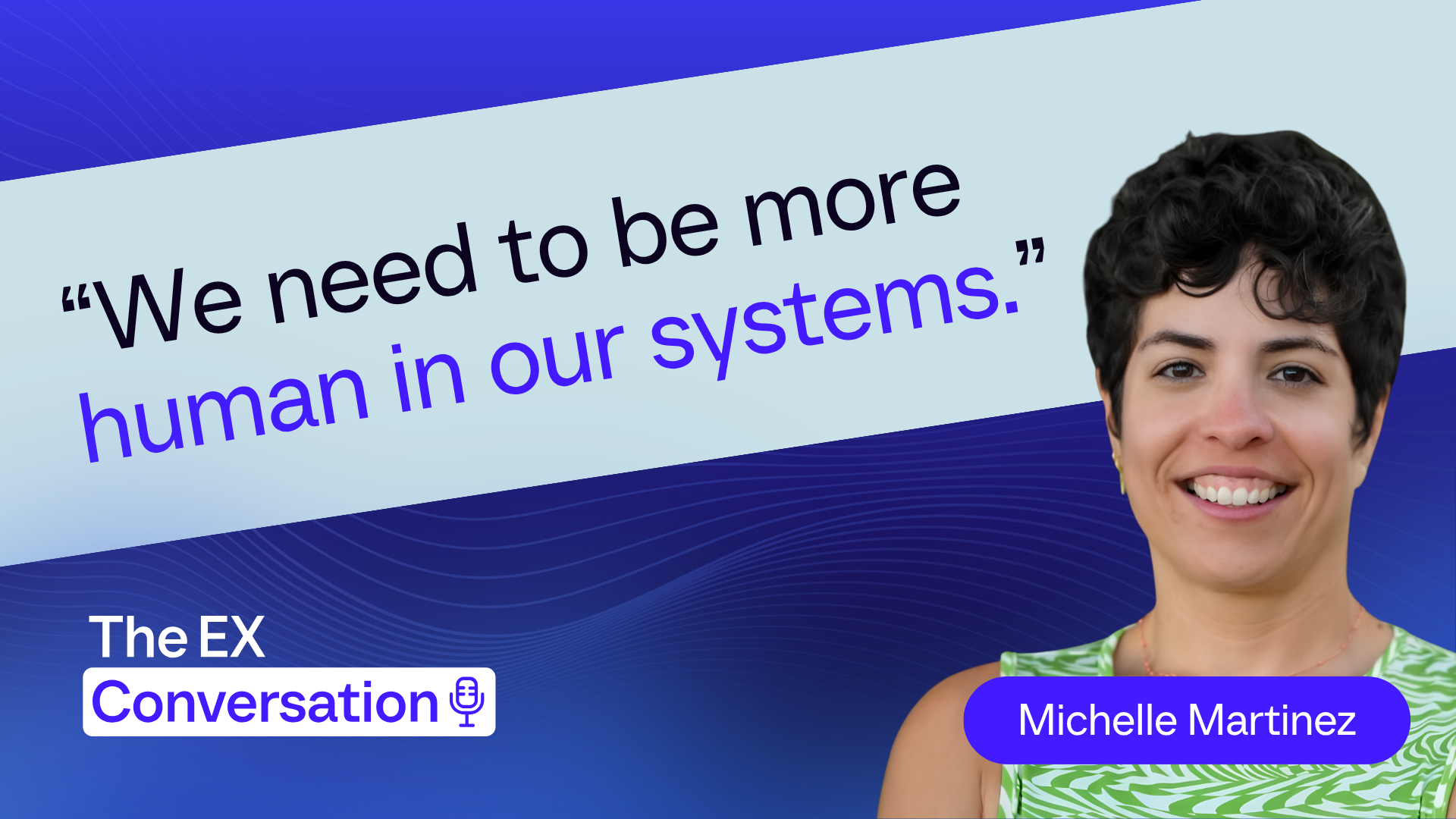
That’s part of what made this conversation with Michelle Martinez so interesting on The EX Conversation. Michelle has spent the last 15 years leading software and engineering teams across industries, from nonprofits to global manufacturing organizations. But despite her technical background, her core argument is surprisingly simple: technology is rarely the hard part. People are.
What stood out most wasn’t a new framework or trend prediction. It was her practical view of what actually helps teams function when work becomes messy, fast-moving, and uncertain.
1. High-performing teams are built on psychological safety, not better tools
One of the strongest themes from the conversation was Michelle's insistence that organizations often overestimate the importance of technology and underestimate the importance of trust.
As she put it:
“The number one indicator of success is actually psychological safety and trust on teams.”
For EX leaders, that observation matters because most organizations still default to solving operational friction with more tooling, more systems, or more process. But Michelle pointed to research from DORA showing that successful engineering teams are differentiated less by their platforms and more by how safely people can communicate, experiment, and fail together.
What’s interesting is how she operationalizes that idea. She doesn’t treat psychological safety as a culture initiative sitting outside the work. She embeds it directly into delivery processes.
Michelle described the standard DevOps rhythm — investigate, design, build, deploy — not just as a technical methodology, but as a structure for alignment and trust-building. The investigation phase becomes the moment teams align around problems together. Design becomes the point where business and technical realities meet. Development requires engineers to stop needing to be “the expert in the room” all the time.
That’s a subtle but important shift for EX leaders. Instead of treating trust as something separate from execution, she frames trust as part of execution itself.
In practice, that mindset also changes how organizations approach collaboration. Instead of assuming teams need tighter controls and more oversight as work becomes more complex, Michelle argues they need better ways to communicate uncertainty safely and early.
2. Organizations are becoming more human — not less technical
There’s a common assumption that as AI adoption accelerates, work will become colder, more automated, and more technical. Michelle sees almost the opposite happening.
“The answer is acting more human,” she said when discussing the future of work across technical and non-technical teams.
That perspective feels especially relevant for EX leaders trying to navigate the current AI conversation internally. Many organizations are still treating AI as primarily a governance or tooling challenge. Michelle's view is that the bigger challenge is designing systems where people can actually function like humans.
She described modern workplaces as environments overloaded with collaboration, requests, competing priorities, and cross-functional complexity. Her response isn’t to eliminate complexity entirely. It’s to create operating models that acknowledge people’s real lives and limitations.
One example she shared was surprisingly simple: asynchronous work practices that allow people to contribute when they realistically can, rather than forcing everyone into constant real-time coordination. Another was the importance of leaders openly acknowledging personal realities — parenting responsibilities, capacity limits, energy constraints — rather than pretending those things sit outside professional performance.
There’s also an important implication here for employee experience teams themselves.
Michelle believes the traditional boundaries between “the business” and “IT” are disappearing quickly, particularly with AI making development more accessible to non-engineers. Her prediction was blunt:
“I think in the future everyone is going to be a software developer manager at some level.”
That means EX leaders can’t afford to treat technology decisions as someone else’s domain anymore. But it also means technical teams can’t operate separately from employee realities either.
The organizations that adapt fastest may not be the ones with the most advanced AI strategy. They may be the ones that help technical and non-technical teams work together without exhausting each other in the process.
Episode 13: Building Human-Centered Tech Teams with Michelle Martinez

3. The biggest EX mistakes happen when organizations optimize for speed over fit
One of the more grounded parts of the conversation centered on hiring and team design.
Michelle pushed back hard against the pressure many organizations feel to move faster at all costs, especially in technical hiring. Her argument was straightforward: hiring the wrong person compounds operational problems for years.
What stood out wasn’t just her emphasis on slowing down hiring decisions. It was how she evaluates talent.
Despite working in highly technical environments, Michelle said she pays far less attention to certifications and credentials than many organizations do. Instead, she looks for evidence of problem-solving, adaptability, and real-world experience — especially experiences that may not initially look “technical” on paper.
That philosophy connects directly to employee experience.
Too often, organizations separate hiring quality from workplace culture, engagement, or wellbeing conversations. Michelle sees them as inseparable. The people brought into a team shape communication norms, trust levels, collaboration quality, and ultimately performance.
She also challenged a common assumption in workplace wellbeing conversations: that growth and resilience are primarily individual responsibilities.
“We need to throw away the idea that performance and growth are individual responsibilities.”
Instead, she argued that organizations spend too much time giving employees stress-management tools while ignoring the environments creating the stress in the first place. Apps and wellbeing resources matter, but they can’t compensate for systems that isolate people, overload them, or prevent meaningful connection.
That’s a challenge many EX leaders will recognize immediately.
It’s much easier organizationally to offer support resources than to redesign how work actually happens. But Michelle's point is that sustainable performance comes less from individual optimization and more from healthy social systems.
Why this matters
What makes Martinez’s perspective useful for EX leaders is that it avoids both extremes that dominate workplace conversations right now.
She isn’t dismissing technology, AI, or operational rigor. But she’s also not romanticizing culture or collaboration in abstract terms. Instead, her thinking sits in the uncomfortable middle where most organizations actually operate: high pressure, imperfect information, shifting priorities, and constant change.
Her approach offers a more practical lens for EX leaders trying to move forward without waiting for perfect clarity.
Focus on trust as part of execution, not separate from it. Design systems that acknowledge people are human beings, not infinitely scalable resources. And pay closer attention to the environments shaping employee behavior, not just the behaviors themselves.
That kind of thinking helps leaders make better decisions now, even when the future still feels messy.
Want the full conversation?
If this conversation resonated, the full episode of The EX Conversation explores additional themes around AI, DevOps, communication between technical and non-technical teams, and what more human-centered organizations could look like over the next few years.
Get started. Get your personalized demo.