
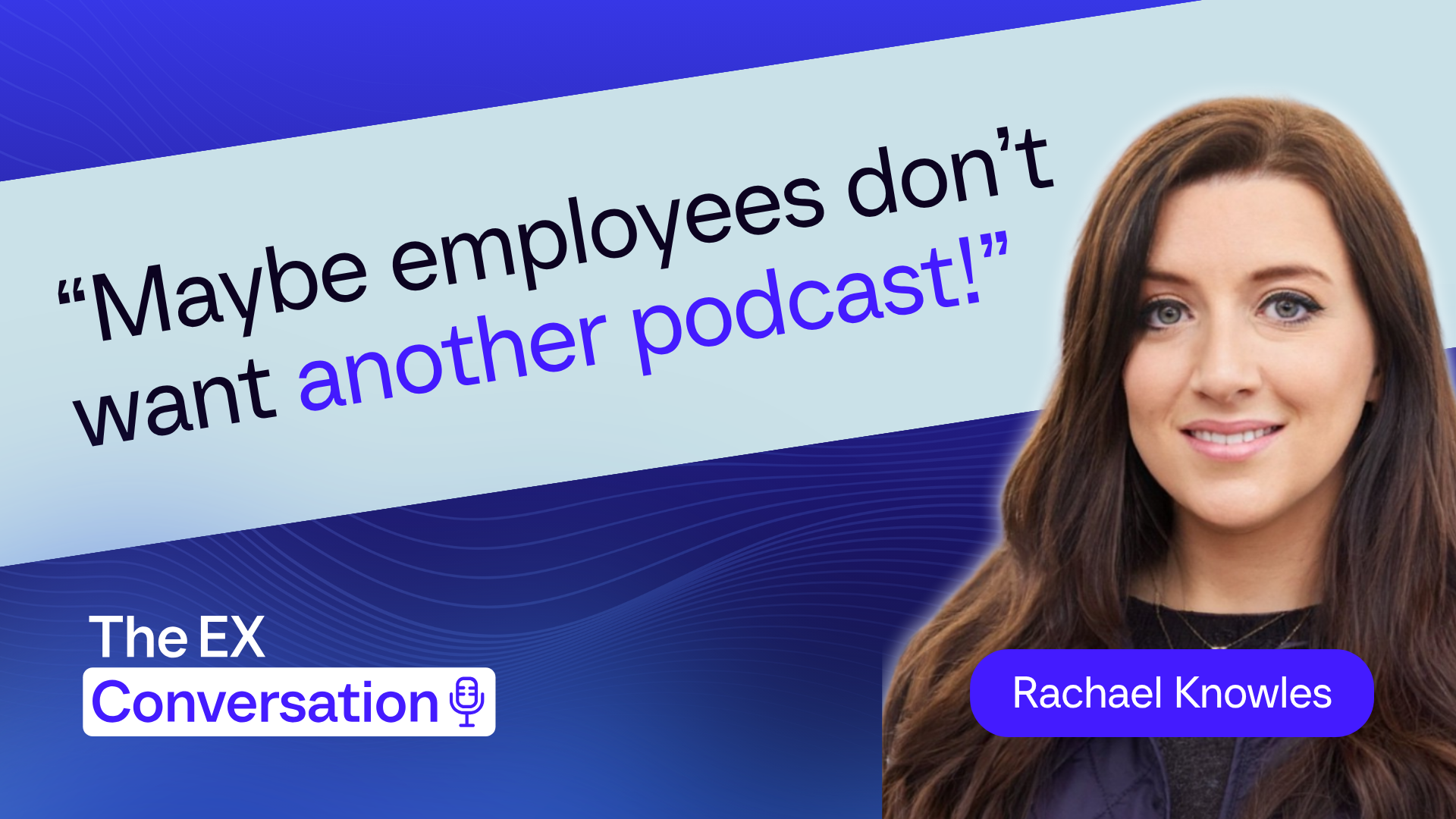
That tension came through clearly in a recent episode of The EX Conversation featuring Rachael Knowles. Drawing on experience across hospitality, travel, and frontline-heavy organizations, Rachael spoke candidly about what actually works when you’re trying to reach employees who don’t sit behind desks all day — and where EX teams can accidentally lose sight of the people they’re trying to serve.
Rather than offering polished “best practices,” the conversation focused on trade-offs, changing workforce expectations, and the reality of making communication decisions without perfect answers. Three themes stood out.
1. Great EX starts with understanding how people actually work
One of the strongest threads throughout the conversation was Rachael’s focus on operational reality. Not theory. Not channel trends. Just the practical reality of how people experience work day to day.
Reflecting on her time leading internal communications at Kerzner International and Atlantis The Palm, she described an environment where communicators had to deeply understand frontline work in order to create anything useful.
“You had to really know the property so well, you had to know the people so well and really form those relationships and those connections with them in order to produce that content.”
That mindset shaped how the company approached its employee platform. Instead of treating the intranet as a publishing destination, they embedded it into operational workflows: rosters, leave requests, payslips, travel perks, schedules, and day-to-day coordination.
The result wasn’t engagement driven by novelty. It was usefulness.
Rachael explained that employees weren’t just checking the platform at work — they were logging in while traveling or visiting family because it had become part of how they managed their working lives.
That’s an important distinction for EX leaders. Too often, engagement strategies focus on producing better content when the bigger opportunity is reducing friction in employees’ actual experience of work.
The lesson here isn’t “build a better intranet.” It’s that adoption happens when communication tools become operationally relevant, especially for frontline teams who don’t have spare time to browse corporate updates.
2. Not every communication trend survives contact with frontline reality
One of the most refreshingly honest moments in the discussion came when Rachael admitted she was “falling out of love” with workplace podcasts.
Not because podcasts are inherently bad. She loves podcasts personally. The issue is context.
As she put it:
“What doesn’t really fit perfectly is a 45-minute piece of long form content in the workplace when I’ve got a customer coming in to sit in front of me in five minutes time.”
That observation gets at a broader challenge inside EX and internal communications right now: leaders often confuse their own working patterns with everyone else’s.
Senior leaders and support functions may absolutely have time to consume long-form content during commutes or between meetings. Frontline employees usually do not. Rachael repeatedly came back to the idea that communicators need to design for the reality of people’s days, not for the formats currently trending on LinkedIn.
Importantly, she wasn’t arguing against experimentation. Her team has still tested creative formats, including a workplace version of Hot Ones featuring company leaders eating increasingly spicy food while answering questions.
But even there, she was clear-eyed about the trade-offs:
“It can be a distraction from things that are actually going to move the needle.”
That’s the kind of tension many EX teams are navigating right now. Creativity matters. Attention matters. Leadership visibility matters. But every hour spent producing high-effort content is an hour not spent solving operational communication problems.
Rachael’s perspective is a useful reminder that communication effectiveness is rarely about producing the most exciting content. It’s about matching the format to the audience’s reality.
Episode 12: Creating Connection in Customer-Facing Workplaces with Rachael Knowles

3. Deep listening is still one of the most underrated EX skills
Another standout theme was Rachael’s defense of introversion as a leadership strength in communications and employee experience.
In industries that often reward visibility, energy, and confidence, she argued that quieter skills are frequently undervalued.
“Introversion definitely is my super power.”
She connected that directly to communication work: listening deeply, spotting emotional signals, noticing hesitation, and understanding what people are avoiding saying altogether.
“Listening for what’s not being said.”
That idea surfaced again when discussing engagement metrics. Rachael admitted she has intentionally spent less time obsessing over open rates and click-throughs recently because, in her view, those metrics rarely tell the full story.
An email open might simply reflect timing. A click doesn’t necessarily mean trust. Strong engagement metrics can still coexist with confusion, skepticism, or misalignment inside the organization.
For experienced EX leaders, this probably feels familiar. Some of the most important signals inside organizations are qualitative, subtle, and difficult to quantify cleanly.
That doesn’t mean data is irrelevant. It means interpretation matters more than dashboards alone.
Rachael’s approach highlights a skill that often gets overlooked in discussions about EX maturity: the ability to synthesize sentiment from incomplete information and make thoughtful decisions anyway.
Why this matters
What makes Rachael’s perspective compelling is that it avoids the usual extremes.
There’s no claim that technology solves everything. No rejection of innovation either. No suggestion that EX leaders simply need more data, more content, or better platforms.
Instead, her thinking reflects something many experienced EX leaders eventually learn: employee experience work is mostly about judgment.
Understanding how people actually work. Knowing when a trend fits your audience and when it doesn’t. Recognizing that metrics are signals, not truth. Listening carefully enough to notice what people are reluctant to say directly.
That kind of thinking helps teams move forward even when the data is incomplete or contradictory. It also helps communicators explain decisions more credibly to leadership because the reasoning is grounded in operational reality rather than communication fashion.
In complex organizations, that practical realism often matters more than having the perfect strategy deck.
Want the full conversation?
If these themes resonated, the full episode of The EX Conversation with Rachael Knowles is worth exploring in full. The discussion goes deeper into frontline communication challenges, leadership expectations, employee attention spans, and the realities of balancing creativity with impact inside modern EX teams.
Get started. Get your personalized demo.