

Executive Summary
Across nearly every industry, a new class of organization is reshaping competitive landscapes.
Mid-enterprise companies, typically organizations with 1,000 to 10,000 employees, are increasingly disrupting long-established incumbents. These companies move faster, adopt emerging technologies earlier, and empower employees to act with greater autonomy.
Their competitive advantage is not scale. It is speed.
Speed of innovation. Speed of execution. Speed to market. Speed to knowledge.
But as these organizations grow, a familiar challenge emerges: digital friction. Employees face navigating dozens of disconnected systems to find information, complete tasks, and collaborate with colleagues. Knowledge becomes fragmented across platforms. Actions require multiple logins and several steps. Valuable minutes are lost switching between tools. Over time, this friction compounds into a measurable drag on performance.
Knowledge workers toggle between applications nearly 1,200 times a day, losing almost four hours per week - around five working weeks per year - simply reorienting themselves after switching tools. (Harvard Business Review, 2022)
For organizations competing on speed, this challenge is more than operational, it’s strategic.
This guide explores:
- why digital friction has become a major constraint on modern organizations
- how fragmented systems slow innovation and decision-making
- why employee experience platforms are emerging as the digital front door of the enterprise
- how integration strategies evolve across five levels of maturity
- how AI-powered experiences like Unily Glass enable employees to move from information to action
The organizations that win in the next decade will not simply deploy more technology. They will be the ones orchestrating that technology intelligently.
Discover how integration strategies can support enterprise growth

The Mid-Enterprise Advantage - And Its Hidden Risk
Mid-enterprise organizations often outperform larger competitors because they move faster. Without the structural inertia of larger enterprises, they can experiment, iterate, and launch faster than incumbents.
This speed translates directly into competitive advantage. One of the clearest examples is time-to-market. Organizations that can move from idea to launch faster, frequently capture market share before competitors can respond.
McKinsey research found that a product launched six months late to market earns 33% less profit over five years - yet a product released on time but 50% over budget loses only around 4%. (McKinsey & Company)
However, as these companies scale, they see complexity grow. New functions require new systems. New workflows require new tools. New teams introduce new platforms.
Over time, the digital workplace expands into a patchwork of enterprise software: HR systems, knowledge platforms, CRM tools, analytics environments, IT service systems, operational applications and more.
Each platform may perform its role well. But together they create fragmentation. Employees are having to navigate multiple systems simply to complete everyday work. The result is digital friction. And digital friction is what slows the very organizations whose success depends on speed.
The Digital Front Door : A New Model for the Digital Workplace
To address fragmentation, many organizations are adopting a new architectural model: the digital front door.
A digital front door provides employees with a unified starting point for work. Rather than navigating multiple enterprise systems individually, employees access information, services, and applications through a single experience layer.
In modern organizations, this role is increasingly fulfilled by an Employee Experience Platform (EXP). An EXP connects the organization’s technology ecosystem and presents it through a consistent interface accessible from desktop or mobile devices.
Instead of employees having to adapt to enterprise software, it’s the systems that are organized around the employee experience.
This approach delivers several advantages. Employees begin work in a single place. Applications become easier to access. Information from multiple systems can appear together. Knowledge becomes easier to discover.
For frontline employees or workers on the move, this experience becomes particularly valuable. Operational updates, schedules, and services become accessible from a mobile device without navigating multiple enterprise applications.
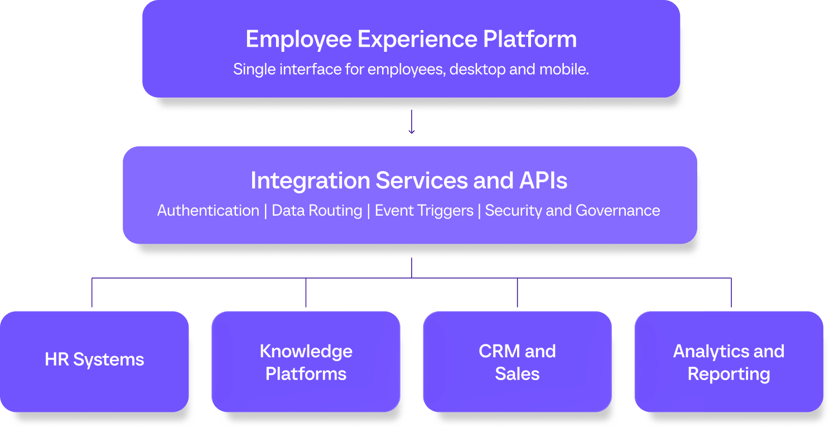
The EXP becomes the experience layer of the enterprise, while underlying systems remain flexible.
Strategic Benefit: Experience Abstraction
This architecture also introduces a strategic advantage: experience abstraction.
Large enterprise vendors increasingly attempt to become the central platform for organizations. But mid-enterprise companies rarely have the influence to shape those vendors’ roadmaps. Without abstraction, organizations become dependent on a single vendor’s strategic direction.
The employee experience platform solves this by acting as a stable experience layer. If an organization replaces an underlying system, for example switching HR providers, the change occurs behind the platform.
Employees continue working through the same digital front door. For organizations navigating rapid growth and change, this flexibility becomes a powerful accelerator.


Ready to Build Your Evaluation Shortlist?
Get the complete buyer's guide with vendor scorecards, requirements worksheets, stakeholder planning frameworks, and evaluation criteria designed to help growing organizations make a confident intranet decision.
Download the Full Buyer's Guide
Integration Maturity: A Stairway to a Frictionless Workplace
Removing digital friction rarely happens in a single step. Organizations typically evolve their digital workplace through multiple stages of integration maturity. Each stage reduces friction further while enabling faster access to knowledge, services, and action.
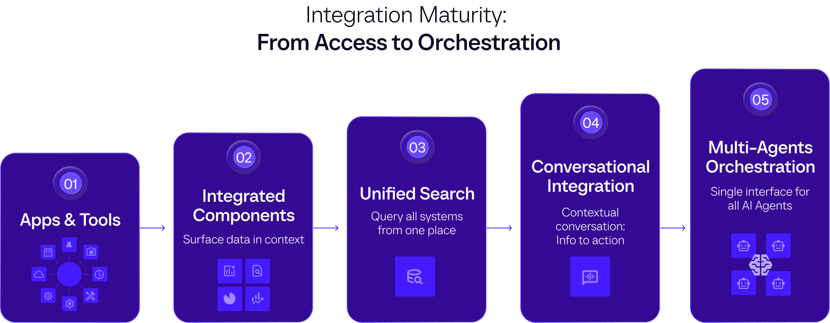
Level 1: Apps & Tools: Simplifying Access
The first stage of integration focuses on simplifying how employees access enterprise systems.
In many organizations, employees rely on dozens of applications but struggle to locate them quickly. Centralized app directories and deep links remove this barrier by allowing employees to launch systems directly from the digital front door. For knowledge workers, this might mean opening a project workspace instantly. For frontline employees, it might mean accessing a shift schedule from the mobile app without navigating multiple tools.
This approach delivers immediate productivity benefits by reducing the time required to locate and launch applications. However, it does not yet solve deeper fragmentation challenges. Employees still move between systems to retrieve information or complete tasks.
The apps remain separate; the platform simply makes them easier to reach.
Level 2: Integrated Components : Bringing Systems into Context
The second stage of integration begins to address fragmentation more directly. Instead of simply linking to external systems, organizations can surface data from those systems directly within the employee experience platform.
Integrated components allow information from multiple sources to appear together within a shared workspace. For example, a team page might display project milestones, relevant documents, and team announcements drawn from several systems simultaneously. For frontline employees, this might mean seeing operational updates or schedules directly within the mobile interface. This approach reduces the need to navigate between systems and provides greater contextual understanding of work.
It also introduces another important advantage: user experience consistency.
Enterprise systems often vary significantly in usability. Some tools have modern interfaces, while others are optimized primarily for desktop environments. By presenting system data through the employee experience platform, organizations can deliver a more consistent and mobile-friendly experience.
However, this approach has limitations. Integrated components are typically tied to specific pages or contexts. Employees benefit from the information when they visit those spaces, but discovering new knowledge still requires navigating the platform.
This leads naturally to the next stage of maturity.
Unily Glass Product Tour

Level 3: Unified Search: Accelerating Speed to Knowledge
Even in well-organized digital workplaces, employees often begin with a simple question: Where is the information I need?
Unified search addresses this challenge by allowing employees to query multiple connected repositories from a single interface. Instead of searching multiple systems individually, employees search once and retrieve results from across the digital workplace.
This dramatically improves speed to knowledge, enabling faster decision-making and reducing time spent hunting for information.
Employees spend nearly 59 minutes every day searching for information — time that could be reclaimed through unified search across connected systems. (Squeeze Growth / UC Irvine research synthesis, 2025)
Unified search focuses primarily on discovery and retrieval.
Employees find relevant information and then open it within the appropriate system. While this significantly improves knowledge discovery, it still requires employees to move between systems to take action.
The next stage removes that final barrier.
Calculate the business impact of your intranet
See how much time, cost, and productivity value Unily could deliver for your organization.
Level 4: Conversational Integration: From Information to Action with Unily Glass
Conversational interfaces represent the next major evolution in integration. Instead of navigating interfaces or typing structured search queries, employees interact with enterprise systems using natural language.
Unily Glass provides this capability within the employee experience platform. Through a spoken, conversational interface, employees can retrieve information from multiple enterprise systems simply by asking questions.
However, the true power of Unily Glass lies in its ability to support transactions as well as retrieval. Employees can complete tasks such as submitting requests, updating records, or triggering workflows directly within the conversation.
This removes several layers of navigation from everyday workflows. Instead of locating a system, navigating menus, and completing forms, employees move directly from information to action. For fast-moving organizations, this dramatically accelerates the pace of work.
Level 5: Multi-Agent Integration: Orchestrating the AI Workforce
As organizations adopt AI at scale, they often introduce multiple AI agents across different systems. These agents may support HR queries, service requests, knowledge retrieval, or workflow automation. While these tools promise efficiency gains, they can also introduce a new form of fragmentation. Employees may struggle to determine which AI agent is best suited to a particular task.
Navigating between agents can quickly recreate the same digital complexity organizations worked to eliminate. A unified experience layer solves this challenge.
Through the employee experience platform, conversational interfaces like Unily Glass can route queries to the appropriate underlying agent while maintaining a single interface for employees.
This orchestration provides several advantages:
- First, it removes the cognitive burden of choosing the correct AI tool.
- Second, it reinforces trust in enterprise AI. Because the experience is delivered through an authoritative platform used across the organization, employees gain confidence that the AI tools they are interacting with are approved, governed, and aligned with company knowledge.
- Third, it accelerates AI adoption by embedding new capabilities directly within the flow of work rather than introducing new tools employees must learn independently.
In this model, the employee experience platform becomes the control center of the enterprise AI ecosystem.
Conclusion: A Multi-Pronged Strategy for Removing Digital Friction
Eliminating digital friction requires more than a single integration approach. Different systems and workflows benefit from different integration models.
Some applications are best accessed through simple deep links, so rebuilding their entire interface would provide little value. Other systems benefit from integrated components that surface contextual information alongside related work. Knowledge repositories are often best served through unified search, enabling rapid discovery of information across systems. Conversational interfaces like Unily Glass enable employees to move beyond discovery and into action.
Finally, as organizations deploy multiple AI agents, orchestration layers ensure these tools enhance productivity rather than introduce new complexity. For mid-enterprise organizations competing on speed, the goal is not simply integration. The goal is intelligent orchestration of digital experiences.
By combining multiple integration approaches within a unified employee experience platform, organizations can remove digital friction and enable employees to work faster, make better decisions, and bring innovations to market sooner.
In a world where speed defines competitive advantage, the organizations that succeed will be those that make work simpler, faster, and more connected.
Discover Why Unily is the Most Recognized EXP Leader →

Get started. Get your personalized demo.