
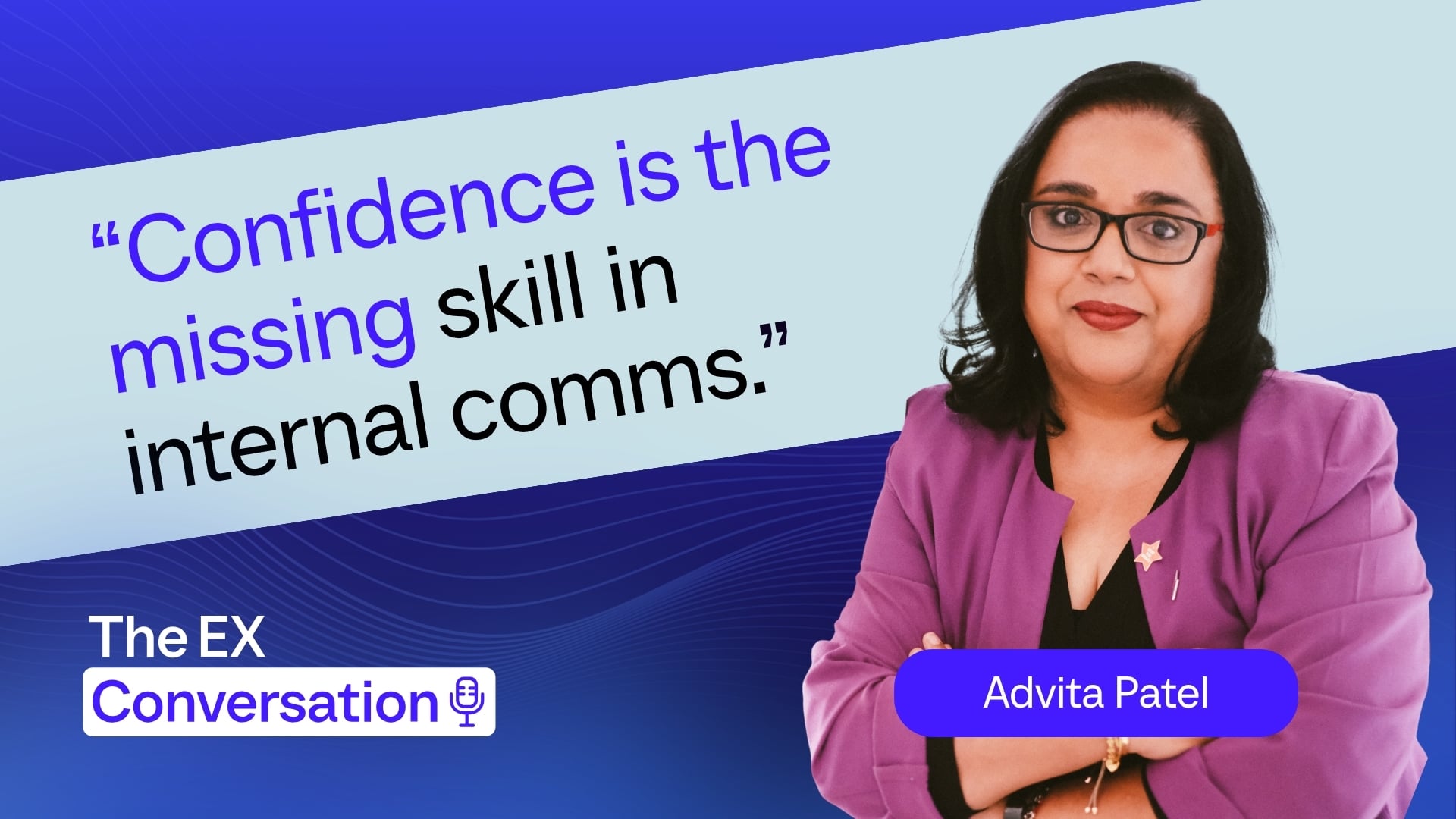
In a recent episode of The EX Conversation, Advita Patel, internal communications leader, founder, and author, offered a grounded, experience-led perspective on what really holds EX and comms professionals back. Her career spans two decades in internal comms, but what stands out isn’t just her experience—it’s how candidly she reflects on the realities of working in the function.
This isn’t a conversation about tools or frameworks. It’s about how EX leaders actually operate in the grey areas, and what needs to shift.
1. The problem isn’t capability—it’s self-belief
Most EX and internal comms professionals know what good looks like. The issue isn’t technical skill. It’s what happens when that expertise meets resistance.
As Advita put it:
“I believe that most internal comms folks who have been in the profession for a period of time know what good looks like and what good doesn't look like… the struggles we have is that we don’t believe in ourselves.”
That lack of belief shows up in familiar ways—hesitation to challenge, over-accommodation of stakeholders, or defaulting to execution rather than influence. Over time, it creates a pattern: capable professionals waiting for permission instead of shaping direction.
Advita’s own experience highlights how ingrained this can become. She describes spending over a decade “waiting for permission and validation” before stepping forward on her own terms. That’s not unusual in EX—it’s often how the function has been conditioned to operate.
Her reframing is simple but powerful: confidence isn’t about being louder or more visible. It’s about trust—trusting your judgment, your expertise, and your ability to navigate pushback without spiraling.
In practice, that means shifting from “Am I allowed to say this?” to “What’s the right thing to say here?”
2. Internal comms still defaults to conformity—at a cost
There’s a tension at the heart of EX and internal comms: the need to influence, without always feeling able to challenge.
Advita describes this clearly:
“We’re still very careful about how we position ourselves… we probably don’t challenge as hard as our marketing friends would do.”
Historically, that caution made sense. Internal comms was expected to support leadership, not question it. But that legacy still shapes behavior today—even as expectations of the function evolve.
The result? EX teams often find themselves brought in late, asked to “package” decisions rather than shape them. And when that happens repeatedly, it reinforces the perception that the function is tactical.
Advita’s perspective is pragmatic rather than idealistic. She doesn’t suggest confrontation for its own sake. Instead, she points to a more effective shift: positioning EX as a business discipline, not just a communications one.
Her framing is worth noting:
“We’re business leaders with communications expertise.”
That shift changes the conversation. Instead of debating channels or messaging, you’re discussing risk, impact, and outcomes—areas leaders already care about.
It’s not about being louder. It’s about being more relevant.
Episode 9: Building Confidence, Challenging Conformity, and Finding Your Voice with Advita Patel

3. EX leaders are under-investing in themselves
There’s a consistent pattern across EX and internal comms: a strong focus on supporting others, with very little focus on personal capability.
Advita connects this directly to confidence—and ultimately, performance:
“We’re so focused on other people… we’re often the last group to be thought of… nobody really checks in on us.”
That imbalance has real consequences. Burnout is common. Self-doubt creeps in. And over time, even experienced professionals start to retreat rather than step forward.
One of the more practical insights from the conversation is her emphasis on energy. Not in a vague sense, but as a measurable, manageable input to performance.
If energy is depleted—through constant reactive work, lack of boundaries, or emotional strain—everything else becomes harder: decision-making, influencing, even basic confidence.
This is where her focus on self-discovery comes in. Understanding how you work, what triggers you, and where you lose confidence isn’t a “nice to have.” It’s foundational.
Because without that clarity, it’s easy to default back to old patterns—seeking approval, avoiding conflict, or over-adapting to others.
Why this matters
Taken together, these insights point to a deeper issue in EX: the gap between capability and conviction.
Most EX leaders don’t lack knowledge. They lack the conditions—and sometimes the confidence—to apply it consistently.
Advita’s perspective offers a more realistic way forward:
- You don’t need perfect data to contribute meaningfully—you need to trust your judgment
- You don’t need permission to influence—you need to frame your thinking in business terms
- You don’t need to fix everything at once—but you do need to understand how you show up
For senior EX leaders, this is especially relevant. The role increasingly sits at the intersection of ambiguity, pressure, and expectation. Waiting for clarity or consensus isn’t always an option.
Progress comes from acting anyway—with enough confidence to stand by your thinking, and enough self-awareness to adapt as you go.
Want the full conversation?
This conversation with Advita Patel is a useful reminder that the biggest barriers in EX aren’t always structural or technical—they’re often personal, cultural, and deeply embedded in how the function has evolved.
If this resonated, it’s worth going back to the full episode of The EX Conversation. There’s more depth in how these ideas connect—particularly around inclusion, leadership, and the realities of operating in today’s environment.
Sometimes the most valuable insight isn’t a new framework. It’s a better way of seeing the challenges you’re already dealing with.
Get started. Get your personalized demo.