
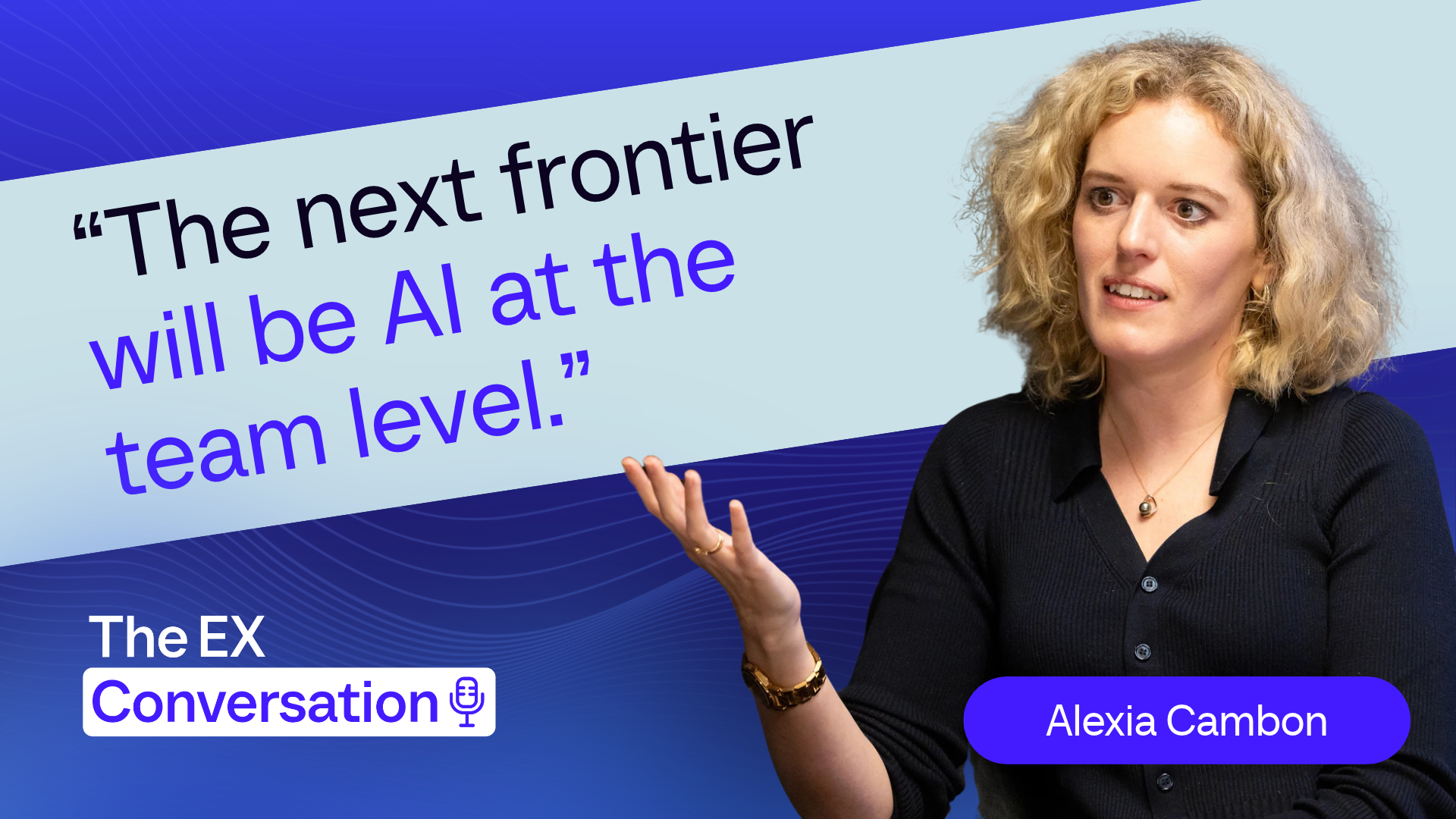
That is the frontier Alexia Cambon, Research Director at Microsoft, is exploring.
Recorded live at Unite 26, this episode of The EX Conversation asks what happens when artificial intelligence and machine learning move beyond individual productivity and become part of how teams think, collaborate and perform.
For Employee Experience, Internal Communications and digital workplace leaders, the implications go far beyond technology. Putting GenAI into workflows also puts it into relationships, team dynamics and organizational culture.
AI’s value lies in what makes it different
Much of the debate around AI starts with comparison to humans. Can it reason like us? Work faster? Replace tasks traditionally performed by people?
Alexia Cambon argues for a different question:
"What can AI contribute precisely because it is different from us?"
Instead of designing AI as a substitute for people, organizations can design for human-AI complementarity: combining the capabilities of technology with human judgment, context, creativity and constructive challenge.
That changes the productivity conversation; the goal is not simply automating repetitive tasks, but redesigning work around what humans and AI can achieve together.
The next frontier of AI is team productivity
Most workplace AI interactions today involve one person asking an assistant to summarize information, leverage predictive or advanced analytics, consolidate data, develop ideas or complete a task.
Alexia Cambon describes this as “me and my Copilot.” The next frontier, she argues, is “multiplayer AI”: multiple people working with AI together, with the technology supporting the group rather than just the individual. She says:
“The future of work shouldn’t really be about just enabling one individual to produce more. I think it should be about enabling groups of people to work more effectively together to produce greater knowledge.”
The potential is collective intelligence: helping teams combine knowledge, coordinate work and develop stronger ideas.
But technology alone cannot create that collective intelligence. The environment in which people use it matters too.
New research from The State of Digital Workplace Experience report by Gallup & Unily offers an important parallel. It defines a strong Digital Workplace Experience through two dimensions:
-
Digital Enablement: whether people can easily access and use the information and tools they need
-
Digital Culture: whether those tools help people connect, learn and feel part of the organization
Just 20% of U.S. employees surveyed had both.
That distinction matters for the future Alexia Cambon describes. Collective intelligence needs more than capable AI. It needs a digital culture in which people are already equipped to connect, learn and work together.
Early versions of multiplayer AI are already emerging, moving beyond basic chatbots and virtual assistants like ChatGPT and Copilot participating in asynchronous chats and Teams Facilitator supporting meetings. But team-level AI brings a harder design challenge. It must navigate multiple goals, perspectives and preferences, judge when to contribute and understand which inputs to prioritize.
Episode 22: Beyond personal productivity - The next frontier of AI at work with Alexia Cambon, Microsoft

AI has no social capital
Organizations do not run on information alone; Work moves through networks of authority, trust and relationships. A manager has "organizational authority". A respected colleague has "credibility". A friend has an interpersonal relationship".
AI starts with none of them.
As Alexia Cambon points out, an AI agent within a team is not your manager, peer or friend. If it starts nudging you to finish a task, why should you listen?
Giving AI access to a workflow does not automatically give it legitimacy within that workflow.
Organizations will need robust AI governance and clear expectations around how AI participates, what authority it has and where human oversight and accountability begin and end.
AI will create new workplace norms
AI cannot be treated like a conventional software rollout.
As Alexia Cambon puts it, this is the first time in human history that workplace technology can “talk back.” Introducing AI means placing a new form of intelligence inside existing workflows, relationships and team dynamics.
New workplace norms will inevitably follow.
One research experiment illustrates the point. During a meeting in which a team was prompting Copilot together, one participant threatened to “shut down” the AI if it failed to complete a task correctly. Other team members immediately challenged how they had spoken to it.
The machine could not be offended. That was not the interesting part.
The more revealing question was this: if we normalize certain behaviors towards AI, could they influence how we behave towards each other?
This is where Employee Experience has a critical role. EX leaders already work at the intersection of culture, behavior, technology and the realities of work. Organizations cannot afford to let new norms form by accident.
The State of the Digital Workplace Experience report reinforces why that culture matters. Employees with good Digital Workplace Experience were 3.1 times more likely to be engaged than those with poor DWX, while frequent burnout was reported by 11% of employees with good DWX compared with 38% of those with poor DWX. The study identifies particularly strong associations between Digital Culture and positive employee outcomes, including higher employee engagement.
The research does not establish that digital culture causes those outcomes. But it does suggest something important for the AI era: the quality of the human environment surrounding technology is as consequential as access to the technology itself.
AI adoption is a communications challenge
Employees need more than messages about AI’s potential. They need an honest understanding of what it means for their work and practical opportunities to build confidence using it.
Alexia Cambon argues that Internal Communications leaders have an important role in acknowledging genuine concerns, such as fears of job loss and job displacement, while creating opportunities for employees to experiment, learn and upskill.
Effective AI communication should:
-
-
Explain why the organization is adopting AI
-
Connect it to real roles and workflows
-
Address uncertainty honestly
-
Create safe opportunities to experiment
-
Make training, upskilling, and reskilling easy to access
-
Share examples from trusted colleagues and leaders
-
Here again, the Unily & Gallup research adds useful context. Almost three in four employees surveyed, 72%, had not participated in employer-provided AI training or learning in the previous six months. The report also found an association between Digital Culture, which includes whether digital tools support learning and development, and higher reported participation in AI training.
AI adoption is not only about capability. It is also about trust. Among employees who use AI, 47% of those with good Digital Workplace Experience said they somewhat or greatly trusted information provided by AI for their work,47% of those with good Digital Workplace Experience said they somewhat or greatly trusted information provided by AI for their work, compared with 26% of those with poor DWX. The report does not find that better DWX makes employees see AI as more useful, but it does find a relationship with their trust in what AI contributes.
That strengthens Alexia Cambon’s point: AI adoption cannot be separated from the wider employee experience around it. Announcing that new AI tools exist isn’t enough - people need to see where it fits into their work and what responsible use looks like.
Access the insights. Move work forward.
Leaders need to make AI use visible
Leadership behavior matters here, too. Research shared by Alexia Cambon suggests that role-modelling and signaling from senior leaders can have a statistically significant impact on employees. When leaders show where AI fits into their own work, that behavior can ripple through the organization.
That does not mean leaders need to present themselves as AI experts. Sharing experiments, lessons and limitations can be more credible than showcasing success stories alone.
For EX, Communications and digital workplace teams, the implication is simple: make responsible AI use visible. And make those examples easy to find. One challenge highlighted by The State of the DWX report is that communication volume does not necessarily create clarity: although 85% of employees surveyed received at least one digital communication from senior leadership in a typical week, 54% said those communications helped them only somewhat or not at all to understand organizational priorities and goals.
In the AI era, more communication is not necessarily the answer. Trusted, relevant communication in the flow of work is.
How to make AI accessible for every employee:
7 AI adoption lessons from Microsoft and Pearson
Don’t build a “human avoidance machine”
Perhaps the most important challenge is deciding which friction AI should remove, and which we need to preserve.
Human colleagues disagree. They question assumptions, introduce unexpected perspectives and force us to explain our thinking. Collaboration can be slower and less comfortable than working with an AI assistant, but that friction can produce stronger ideas, better decision-making and personal growth.
Alexia Cambon warns against creating a “human avoidance machine”: technology that makes it so easy to work around other people that we gradually work with them less.
The better ambition is artificial intelligence that helps us work better with one another.
And there is evidence that today's digital environment can either reinforce or weaken that connection. In the joint Gallup & Unily research, Digital Culture explicitly includes whether technology helps coworkers feel like one team. While 65% of employees said their digital tools helped create that sense of connection, the figure was weaker in the largest organizations: 40% of employees at organizations with 10,000+ people said their tools rarely or never helped coworkers feel like one team.
That gives organizations a useful test for both their digital workplace and their approach to AI: Is AI simply helping people avoid one another, or is it helping them achieve more together?
Three priorities for EX and digital workplace leaders
1. Design for complementarity, not substitution
Ask what humans and AI each contribute to a workflow. Use AI to extend human capabilities without removing the judgment, creativity and constructive disagreement that improve outcomes.
2. Treat AI adoption as organizational change
IT provides the secure, governed technology foundation. But successful adoption also needs Employee Experience, Internal Communications, HR and digital workplace leaders shaping the behaviors, skills and norms surrounding AI. Alexia Cambon is clear:
"AI implementation and transformation should not be managed by IT alone."
The Gallup & Unily research points to the same broader principle from a different direction: Digital Enablement and Digital Culture work best together. Employees with both report the most favorable workplace outcomes.
This is where the combination of Unily and Microsoft becomes relevant. Microsoft provides the tools through which much AI-enabled work takes place; Unily's employee experience platform is designed to connect people, knowledge, tools and communications across desk-based and frontline teams, reducing digital friction and strengthening alignment and culture.
An intranet or employee experience layer therefore has a role beyond simply giving people another destination. It can help create the shared digital environment around Microsoft 365 and Copilot where trusted knowledge, leadership communication, learning and real-world AI use cases are visible and accessible.
3. Look beyond individual productivity
Time saved through GenAI and workflow automation matters, but it is not the whole story.
Organizations should also ask whether AI helps teams share knowledge, make better decisions and collaborate more effectively. Those measures get closer to the collective intelligence that could define the next stage of AI in the workplace.
The Gallup & Unily findings provide a useful reminder that the conditions surrounding that collaboration matter too. Digital Culture encompasses connection, learning, useful leadership communication and recognition, and employees with both strong Digital Culture and Digital Enablement report the most favorable overall employee outcomes.
The future of AI at work is still ours to shape
Organizations have a choice.
They can optimize AI primarily for individual speed and efficiency. Or they can ask a more ambitious question: How can AI help people achieve more together?
For Alexia Cambon, the better future is not one where technology reduces our reliance on each other. It is one where AI helps us collaborate more effectively while preserving the challenge, creativity and connection that make human interaction valuable.
The Gallup & Unily research adds another dimension to that argument. If collective intelligence is the destination, organizations need to create the conditions for it: trusted information, accessible learning, meaningful communication and digital experiences that help people feel connected to their colleagues and organization.
The question is not simply how quickly people adopt AI. It is what kind of workplace we are asking them to adopt it into.
For EX, Internal Communications and digital workplace leaders, that reframes the task ahead.
Want the full conversation?
Watch the full episode of The EX Conversation to hear Alexia Cambon discuss multiplayer AI, collective intelligence and how organizations can shape a more human future of work.