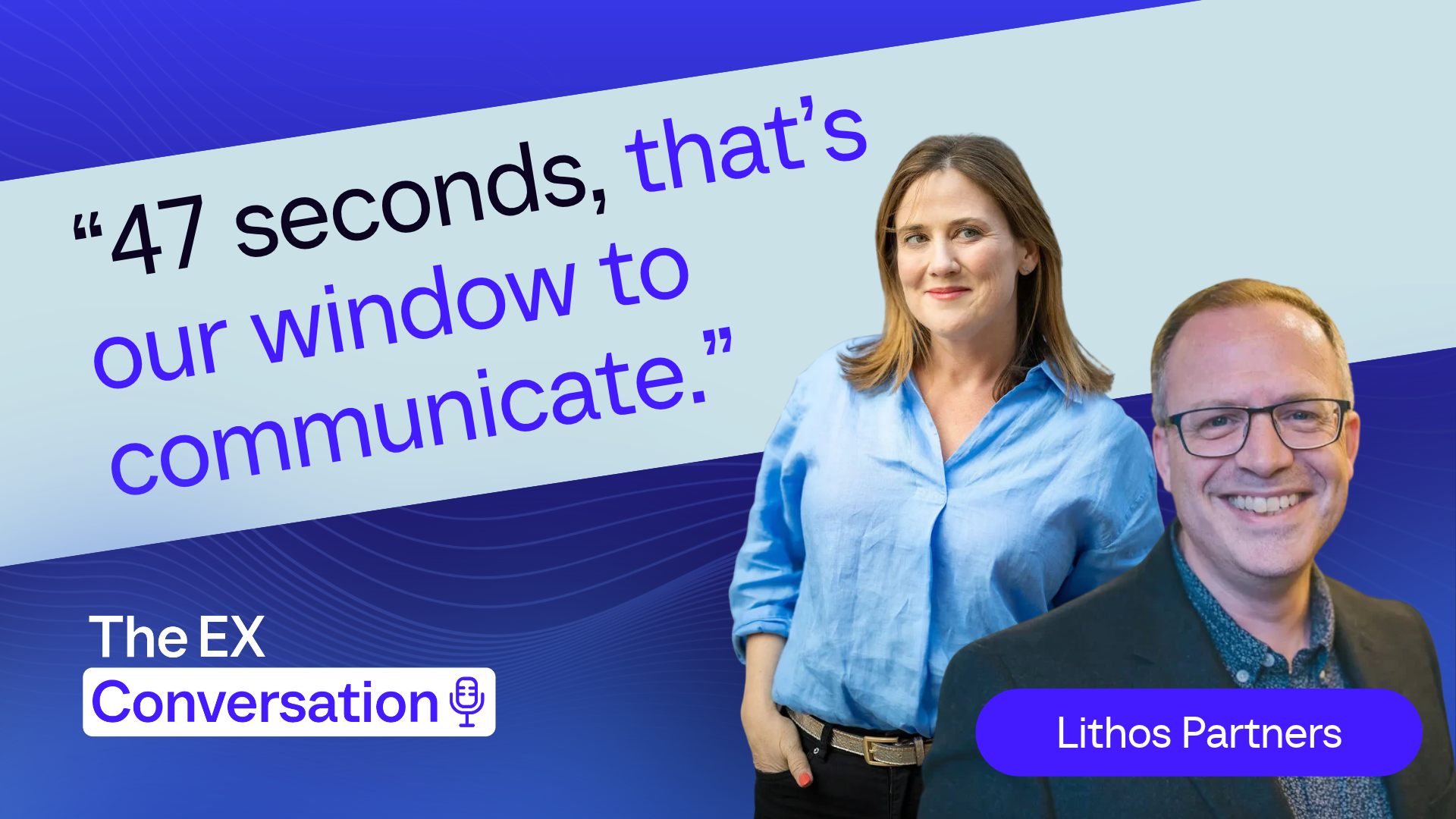
In a recent episode of The EX Conversation, recorded live at Unite 26, Jonathan Phillips and Sharon O'Dea, co-founders of Lithos Partners, explore what it takes to communicate effectively when employees are surrounded by information and communicators have more ways than ever to reach them.
Their argument isn't that we simply need to communicate less. It's that we need to become much more intentional about what we communicate, how we communicate it, and how much attention we're asking employees to give us.
Three ideas stand out:
1. Treat employee attention as a finite resource
There’s a mismatch between how much attention our communications ask for and how much employees actually have available.
Lithos Partners points to research suggesting the average attention window has fallen from around two minutes two decades ago to approximately 47 seconds today. Meanwhile, employees are navigating inboxes, Teams messages, WhatsApp groups and hundreds of other pieces of information competing for their attention.
Jonathan Phillips puts the challenge simply:
“47 seconds is pretty much the window that we're working in.”
Yet internal communications can still default to the five-minute CEO video or the article that takes several minutes to read.
The answer isn't to reduce every communication to a sentence. It's to become more deliberate about how much attention the information actually deserves.
Later in the conversation, Sharon O'Dea introduces a useful principle:
“Use as little attention as that piece of information needs.”
That distinction matters. Some communications simply need employees to know or do something and can get to the point quickly. Others are designed to make people feel something and need richer storytelling and more time.
In practice, that means:
- Start with what an employee actually needs to know, do or feel.
- Match the length and format of the communication to that goal.
- Consider the real window employees have to consume it.
- Save richer, longer communications for moments that genuinely warrant them.
The goal isn't brevity for brevity's sake. It's being mindful of people's time.
2. Communicators, thinking like an orchestrator
For years, internal communications teams have played a central role in producing workplace content. A message comes in, the team identifies the audience, writes it and publishes it.
AI is changing that dynamic.
As Sharon O'Dea explains, everyone can increasingly become a content creator. That means the value of internal communications shifts away from simply producing things and towards making sense of an increasingly crowded information environment.
Jonathan Phillips describes the change as:
“Less postman, less writer, more conductor of an orchestra.”
Internal comms teams, what are we trying to achieve? Who actually needs this information? Which channel fits their working context? Should it be pushed to them, or available for them to pull when relevant?
Lithos Partners describes this as an ecosystem discipline: ensuring that the right information reaches the right people at the right time, rather than treating publishing as the end of the communication process.
One example is their “prescribe and subscribe” model.
Some information really is mandatory: regulatory information or the rare CEO announcement every employee genuinely needs to see. That content should be prescribed. Outside this core, employees can have more control over the topics and information they subscribe to, creating an experience that's more relevant to them.
Episode 21: Winning employee attention in the age of AI with Sharon O'Dea and Jonathan Phillips, Lithos Partners

3. Use AI to fit communication around people, not to create more noise
This is where the conversation becomes particularly relevant to the next era of internal communications.
If employees have different roles, contexts and attention windows, the same communication format won't work equally well for everyone.
Someone working at a desk might be able to read an article. Someone driving for work doesn't have a reading window at all, but may have a listening window. Someone else might only have 30 seconds between tasks.
After seeing Content Studio by Unily, Jonathan Phillips highlighted the potential to take the same trusted source information and adapt it into different communications according to those contexts:
“If you are going to fit into an employee's world, you need to tailor that communication to fit whatever that window is.”
Sharon O'Dea connects this to what she calls the means, opportunity and motive test:
- Means: Can the employee technically access the communication?
- Opportunity: Do they have the time and appropriate format to consume it?
- Motive: Is there a good reason for them to pay attention to it?
AI makes it much easier to flex communication around those variables. The same trusted information could become a 30-second version for someone with a short attention window or audio for someone whose working context makes reading impractical.
But there's an important warning.
Making content easier to create doesn't mean organizations should simply create more of it.
Jonathan Phillips cautions that frictionless content creation could increase the number of communications competing for an already limited attention budget. His recommendation is to retain human judgement about what should actually be produced and published.
That's perhaps the most important distinction.
The opportunity for AI isn't more content; it's more effective communication. Something we coin, the Content Impact Gap.
Why this matters
The tools available to internal communicators are becoming more capable. But employee attention isn't expanding alongside them.
That makes judgement, relevance and context increasingly important.
The conversation with Lithos Partners points towards three practical shifts:
-
Treat attention as a finite resource and use only what you need.
-
Move from producing communications to orchestrating how information reaches employees.
-
Use AI to adapt trusted information around people's needs and context, using tools that help personalize and target content without creating more noise.
The opportunity isn't to fill every available channel with more communication. It's to understand employees well enough to make the important things get notices.
As Sharon O'Dea puts it, communication needs to: “Work for the reality of someone's working day.”
Want the full conversation?
Watch the full episode of The EX Conversation with Jonathan Phillips and Sharon O'Dea from Lithos Partners to hear more about employee attention, the changing role of internal communications, AI, personalization and designing communication around the reality of people's working lives.

Get started. Get your personalized demo.