
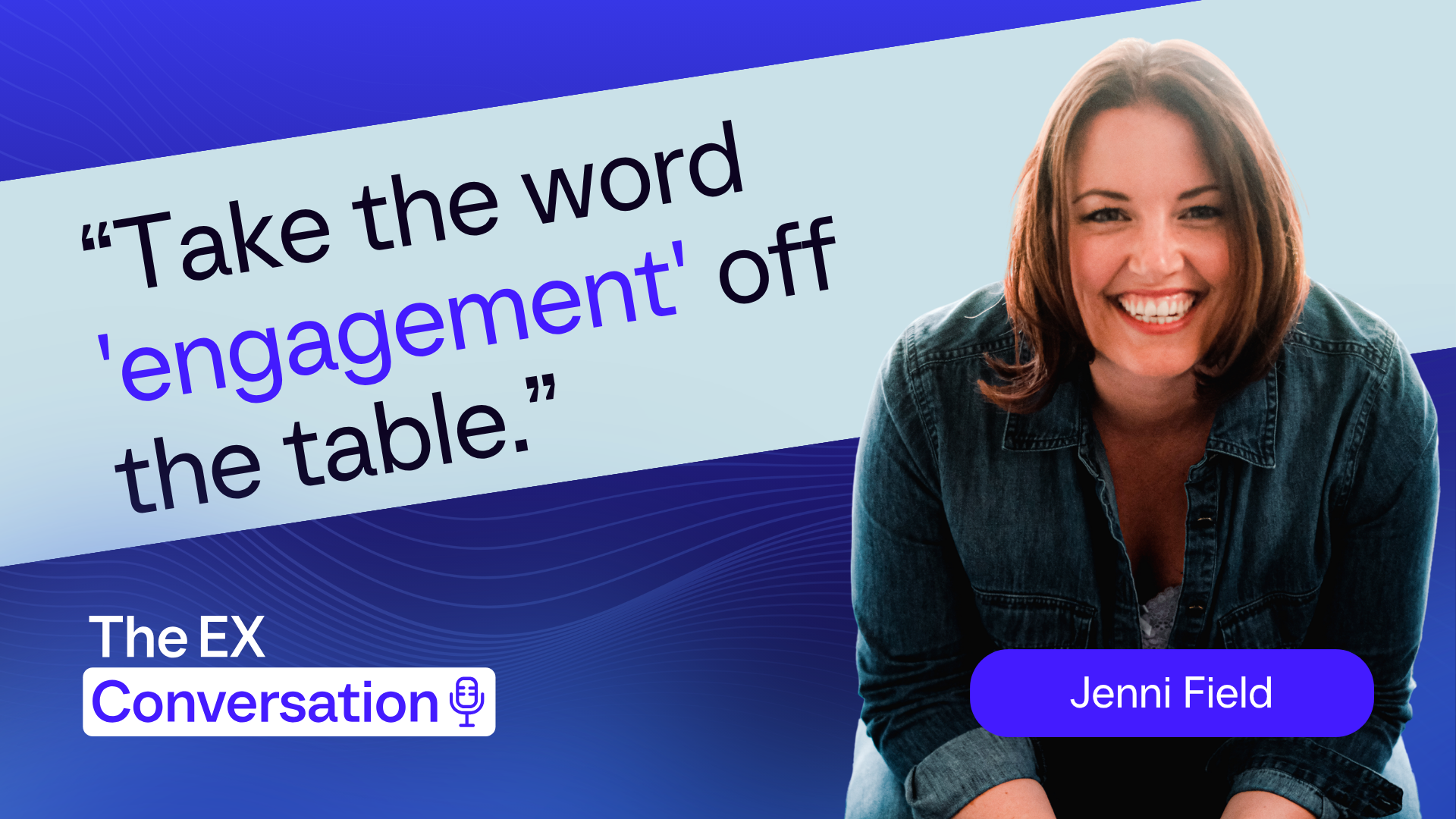
In a recent episode of The EX Conversation, communication consultant, author, and researcher Jenni Field shared why she believes one of the workplace’s most trusted metrics deserves a closer look. Drawing on years of experience building internal communication functions, leading research projects, and advising organizations on culture and leadership, Field challenges some long-held assumptions about how we measure organizational health.
The conversation wasn’t about abandoning measurement altogether. Instead, it explored a more practical question: are we measuring the things that really matter?
1. Employee engagement may be measuring too many things at once
Employee engagement has become the default measure of organizational health. It appears in board reports, annual reports, and leadershipdashboards. Yet Jenni questions whether we’ve become too comfortable accepting it as the answer without challenging what it’s actuallytelling us.
As Jenni put it:
"You can be engaged in the job that you do, but not engaged in the organization."
That distinction matters more than many organizations acknowledge. Someone may love their craft, feel challenged by their work, anddeliver exceptional results while feeling largely disconnected from company values or corporate messaging. Equally, someone mightstrongly believe in an organization's mission while feeling uninspired by their day-to-day role.
The problem, according to Jenni, is that most engagement measures blend these experiences together.
When organizations report a single engagement score, they’re often combining attitudes toward leadership, culture, work itself,development opportunities, team dynamics, flexibility, benefits, and more. The result is a metric that can be difficult to interpret and evenharder to act upon.
Rather than asking whether employees are “engaged,” Jenni suggests leaders should take a step back and ask a more fundamental question:
"Take the word engagement off the table. If that word didn't exist, what is it you're really looking at?"
That shift encourages a more useful conversation about the specific outcomes organizations are trying to create, rather than chasing anumber that may conceal as much as it reveals.
2. The world of work has changed faster than our measures have
One of Jenni’s strongest arguments is that many of our workplace assumptions were shaped during a very different era of work.
For years, highly engaged employees were often described using behaviors we’d be more cautious about celebrating today: staying late, always being available, answering emails at weekends, or prioritizing work above everything else. These expectations sit uneasily alongside today's conversations about wellbeing, flexibility, and healthy boundaries.
As Jenni explained:
"I just don't think the measures of employee engagement have caught up with the role of work in society."
The past few years have fundamentally changed how people think about work. Conversations about burnout, flexibility, wellbeing, boundaries, and mental health are now mainstream. Employees increasingly want work to be an important part of life—not the defining feature of it.
Yet many engagement frameworks were built around older ideas about commitment and loyalty.
This creates a challenge for leaders. If people are establishing healthier boundaries while still doing great work, how should success be measured? If employees are productive, collaborative, and delivering results without making work their entire identity, should lower emotional attachment be viewed as a problem?
Jenni believes these questions deserve more attention than they currently receive.
Instead of focusing on whether engagement scores move by a few percentage points, leaders may benefit from understanding more practical indicators of organizational health: strong management, meaningful work, opportunities for growth, trust, accountability, and effective collaboration.
Those factors may provide a clearer picture of how an organization is functioning than a single number ever could.
Episode 19: Is employee engagement still the right measure? with Jenni Field

3. The behaviors you observe may matter more than the scores you collect
Perhaps the most practical insight from the discussion came when Jenni explored what organizations should focus on if engagement isn't the primary goal.
Her answer wasn't another survey.
Instead, she encouraged leaders to look closely at behavior.
"You tell me what behaviours you want to see and what you don't want to see and then let's look for those."
This perspective shifts measurement away from abstract concepts and toward observable realities.
Are people asking questions?
Are teams willing to challenge ideas constructively?
Do meetings feel inclusive and productive?
Are employees curious, collaborative, and focused on shared goals?
These are often the qualities leaders associate with high-performing teams, yet they don’t always show up clearly in traditional engagement data.
Jenni also emphasized that meaningful work is often linked to clarity and shared purpose. Teams tend to perform best when they understand what they’re working toward and why their contribution matters.
Rather than searching for one definitive metric, organizations may need to become more comfortable evaluating a range of signals. Some will be quantitative. Others will require leaders to pay closer attention to how people work together day to day.
As Jenni noted:
"That's the messy human side of work that nobody wants to do because it's messy and human."
But that messy human reality may ultimately tell us more than a benchmark score ever can.
Why this matters
For EX and internal communications leaders, Jenni’s perspective offers an important reminder: measurement is only valuable if it helps people make better decisions.
The temptation is always to search for a single score that summarizes organizational health. It feels cleaner, easier to report, and simpler to compare. But workplaces rarely operate that way.
People experience work differently. Teams function differently. Cultures evolve over time. The most useful insights often emerge from understanding those nuances rather than compressing them into a single metric.
Thinking beyond engagement allows leaders to focus on what they can actually influence: developing managers, improving communication, creating meaningful work, strengthening trust, and helping teams succeed together.
Most importantly, it helps organizations move forward without waiting for perfect data. Because, as Jenni reflected later in the conversation, much of leadership and organizational life happens in the grey rather than in black and white.
Want the full conversation?
This article captures just a few of the ideas explored in Jenni Field’s conversation on The EX Conversation.
The full episode goes deeper into leadership credibility, workplace behaviors, organizational health, and why communicators should be thinking differently about the signals they use to measure success.
If these ideas resonated, it’s well worth listening to the full discussion. The additional context, nuance, and examples bring even greater depth to a conversation that challenges some of the workplace assumptions many of us have stopped questioning.
Get started. Get your personalized demo.