
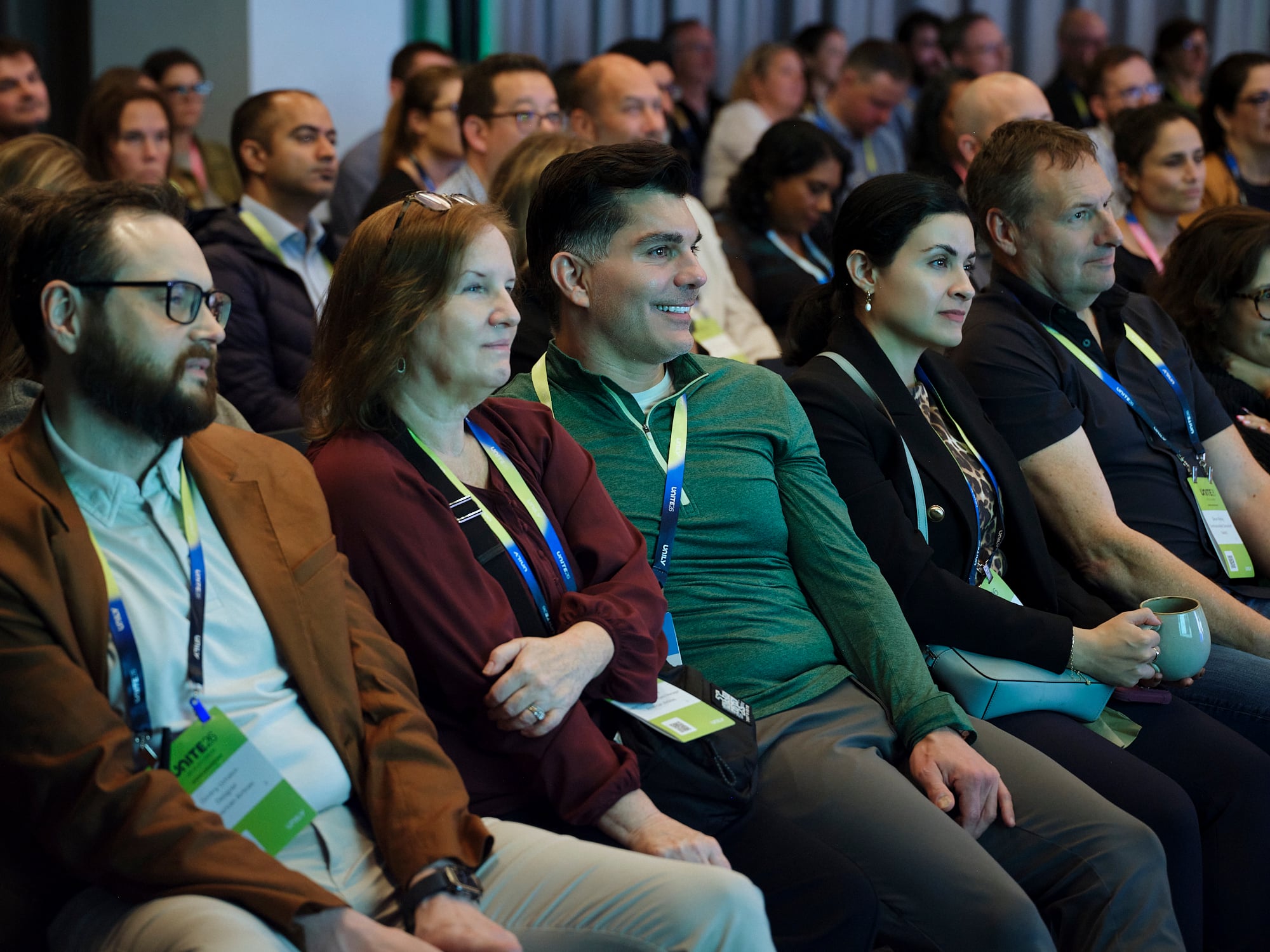
On September 29 and 30, more than 400 internal communications, HR, and digital workplace leaders joined us in London and online for Unite 26. Across three stages and 30 sessions, the program moved between bold ideas, real-world stories, practical workshops, roundtables, and the launch of a brand-new product, Content Studio by Unily.
At the beginning of the event, we asked attendees to do three things: meet someone new, bring a difficult question into the open, and choose one thing they would do differently afterwards. It was an invitation to participate but also a statement of what Unite is for. The person beside you may be solving the same problem, holding a useful piece of the answer, or asking the question that changes how you see it.
That idea carried through the two days. As conversations moved from AI and attention to leadership, communication, and the future of employee experience, the same truth kept resurfacing: technology may help organizations move faster, but the heart of transformation is still human led. People still provide the judgment, context, and confidence that turn movement into meaningful progress.
Looking back, the clearest picture of Unite 26 emerges not from any single keynote or session but from a handful of moments that surfaced again and again in conversation. They came from different speakers, different industries, and different contexts yet all pointed towards the same question: as technology advances, what becomes more important about being human?
Here are the moments and messages at the heart of Unite 26.
When the AI Conversation Became a Question of Judgment
For all the discussion about AI at Unite, one of the sharpest ideas wasn’t about what the technology could do. It was about what becomes more valuable as AI does more.
During the Claiming the Summit panel, Alexia Cambon, Research Director for Microsoft’s New Future of Work initiative, described a fundamental shift in the economics of knowledge work:
“In a world in which you can produce infinite amounts of content, the thing that becomes scarce is human attention and human judgment.”
The observation landed because it named a problem many organizations are already beginning to feel. AI can help people create more documents, messages, images, and ideas, but none of that guarantees greater understanding. If anything, the ease of production increases the burden on employees to decide what deserves their attention, what they can trust, and what should inform their next action.
That means the real opportunity isn’t endless output. It’s the chance to remove work that contributes little and create more room for better decisions, stronger communication, and more useful human contribution.
The panel drew an important distinction between friction that drains people and friction that develops them. Searching across disconnected systems, repeating administrative tasks, or struggling to locate reliable information adds little value. Disagreement, candid feedback, and the effort required to turn an early thought into a strong idea are different. Those experiences can be uncomfortable, but they’re often how judgment improves.


Best-selling author Ryan Holiday brought the same tension down to the scale of an individual task in his keynote. AI can now write an essay in seconds, but the finished document was never the only reason to write one.
“The point is to be the person who wrote the essay. It’s who you are on the other side of it. It’s to have done the thinking.”
Together, those ideas offered a more demanding test for workplace AI. The question isn’t simply whether a task can be completed faster. It’s whether the technology removes work that gets in people’s way or bypasses an experience through which they develop something valuable.
For communicators, the implication is particularly significant. When content becomes easy to generate, communication can't be judged by volume alone. Its value lies in the choices behind it: what needs to be said, whose perspective is missing, how much context people need, and whether the message gives them something clear and trustworthy to act on.
AI may accelerate the process, but people still determine the direction.
When Change Stopped Being Something Done to Employees
A second moment of clarity came as the conversation moved from what AI can do to how organizations can introduce it in a way that drives adoption and value.
Back on the Claiming the Summit Panel, Sam Rope, SVP HR Transformation at The Adecco Group, shared that the starting point wasn’t a list of possible AI use cases devised by a transformation team. Instead, they asked employees which activities in their roles added little value and where work felt unnecessarily difficult. Their answers surfaced problems worth solving and helped the organization identify where AI could offer practical support.


It sounds straightforward, but it changes the dynamic of adoption. Employees are no longer the audience for a finished program developed elsewhere. They’re participants in defining the problem and shaping the response. As Sam explains, “Co-creation really builds trust.” Clear guardrails then give people the freedom to experiment without the fear that one wrong step could put them or their role at risk.
The story was a reminder that people rarely resist change simply because it’s new. They resist when its purpose is unclear, when their experience has been overlooked, or when they feel they have no influence over the outcome. Begin with a problem they recognize, invite them into the work, and adoption becomes less about persuasion and more about participation.
Leadership has to model that participation. Laura Jennings, Deputy Chief Communications Officer at Dentsu, spoke about leaders “solving problems out loud”: showing the thinking behind decisions, allowing a degree of imperfection to remain visible, and replacing the performance of certainty with something more credible.
Research shared by Alexia Cambon demonstrated what visible learning can unlock. During a six-week test, a senior leader sent a weekly message describing how they'd personally used AI. Usage rose by a statistically significant 37% the following day.
Charlene Li’s keynote, Winning the Future of Work, extended that argument from individual judgment to organizational leadership. Her idea of “Goldilocks Governance” challenged leaders to avoid both extremes: controls so tight that experimentation stalls, and an absence of guardrails that leaves people unsure what responsible use looks like. The task is to create enough structure for trust, without closing down the learning needed to turn AI into practical advantage.
The lesson wasn't that every organization needs another leadership email. It was that people watch what leaders do. When leaders experiment openly, share how they're applying a new technology, and acknowledge what they're still learning, they make change feel more accessible to everyone else.
In unfamiliar territory, credibility doesn’t require leaders to pretend they've already reached the destination. It requires them to be visible on the route.


When a Conversation at Unite Became a Story on Stage
Some of the strongest evidence for the value of Unite came not from a keynote but from a customer story that began at an earlier event.
Kim England of Pearson described how seeing Shell present at Unite 25 prompted a follow-up conversation. The idea didn’t leave the event as a neat blueprint ready to copy; it became a starting point. Pearson adapted what the Shell team had learned and turned it into its own Employee Journey evolution: connecting the organization’s past, present, and future through a clearer narrative and a central digital experience.
That progression captures something important about how ideas travel. A speaker shares an experience. Someone in the audience recognizes a possibility. Curiosity leads to a question, the question continues after the session and, over time, the exchange becomes something new inside another organization.
As Kim England puts it, “The most valuable part of Unite might not be the session you attend. It might be the conversation you have afterwards.”


That simple line explains why the spaces around the agenda matter so much. Every major session was paired with a roundtable where a smaller group could test the ideas against the realities of their own organizations. A Customer Community Corner helped people find peers confronting similar challenges. The morning walking tour and sound bath gave attendees a more relaxed way to begin the second day and connect beyond the formal program.
By the start of day two, people had already stayed behind after roundtables to keep talking. From the main stage, those exchanges were described as “the real magic” of Unite.
They were also part of the serious work of the event. Connection is where an idea meets context. It's where someone can admit what didn't work, ask the question that would feel too exposed in a larger room, or learn that another organization has already encountered the problem keeping them awake.
That's what Unite has always been about: not just sharing ideas but helping people make sense of them together. AI and new technology don't create transformation on their own. People do.
When a Product Reveal Became a Practical Answer
The launch of Content Studio by Unily provided one of the event’s biggest stage moments, but its significance became clearer in the conversations that surrounded the announcement.
The workplace doesn’t have a shortage of content. It has trusted knowledge trapped in formats that don’t always fit how people work. One employee may read a detailed article at a desk. Another may listen during a commute. A frontline colleague may rely on a short video, digital signage, or a manager briefing. Reaching those audiences often requires communications teams to recreate the same information repeatedly across different channels and formats.
Content Studio starts with an authoritative source and transforms it into different content expressions while maintaining accuracy, consistency, and governance. The aim isn’t to generate more material simply because AI makes that possible. It’s to help a trusted message travel further and reach employees in a form they can use.


The launch is a practical expression of the wider conversation about attention and judgment at Unite 26. If content can be created endlessly, the answer isn’t to fill every available channel. It’s to begin with something reliable, preserve its meaning, and make deliberate choices about how it should reach people.
One customer’s response captured how immediate the recognition was: “This is a no-brainer. When can I get this? I need it turned on.”
Technology introduces the possibility. People supply the context and the judgment that give it impact.
When a Head Torch Brought the Event Theme into Focus
The emotional center of Unite arrived through an image that had little to do with the workplace at first glance.
During the final night of Bonita Norris’s Everest ascent, the team had been climbing for hours through darkness and extreme cold. Communication had faded as each person became absorbed in the physical effort of taking the next step. At the lowest point of the climb, Bonita Norris began to believe continuing was impossible.
Then a teammate noticed.
The teammate tapped Bonita Norris on the shoulder and asked for the head torch to be switched off. The beam had narrowed the world to the next difficult patch of snow. When the light disappeared and the eyes adjusted, the stars surrounding the mountain came into view.
Nothing about the climb had become easier. The distance had not changed, the cold had not lifted and the exhaustion had not disappeared. But another person had restored the perspective Bonita Norris needed to continue.


That moment gave the event’s theme, Claiming the Summit, its most human meaning.
Everyone at Unite had arrived carrying a different version of the climb: an AI program struggling to gain trust, an overwhelmed workforce, a fragmented employee experience, a communications team being asked to do more or a transformation whose destination was clearer than its route. The event could not complete those journeys on anyone’s behalf. What it could do was help people see the next step differently and connect them with others able to share part of the route.
Bonita Norris also challenged the familiar image of the lone person standing at the summit. Behind that photograph were the Sherpas who had prepared the route, teammates who had shared the effort and people who had noticed when support was needed.
Bonita Norris closed with the words of Tenzing Norgay:
“Be great, make others great.”
It was an apt conclusion for a conference whose theme had always been about a collective climb rather than individual conquest.
Moving from Information to Action After Unite 26
The most useful ideas from Unite weren’t vague predictions filed under AI, leadership, or employee experience. They formed a connected argument about how organizations should approach the next era of work starting with their people.
AI can increase capacity, but people create value. Transformation can move fast, but trust grows when employees are part of the journey. Technology can scale knowledge, but it must protect the context and accuracy that make it trustworthy.
And the distance from idea to action becomes shorter when people share what they've learned. It was the conversations outside the agenda that captured when one person made time for another, when an unfinished thought gained clarity, and when someone realized that the problem they had been carrying was not theirs to solve alone.
That’s the story of Unite 26. Technology may be reshaping what’s possible, but people give possibility its direction. They ask the difficult question, challenge the obvious answer, provide the missing context, and help one another look up when the next step is all they can see.
The stages may now be empty, but the most valuable part of Unite continues in the conversations people carried home and what those conversations make possible next.