The future of work has never been more exciting. Or more complicated. AI promises to make work faster, smarter, and more productive. Yet as organizations race to embrace new technologies, employees are navigating more information, more change, and more demands on their attention than ever before.
It's a paradox that raises an important question: If technology is making so much possible, why isn't it making work simpler?
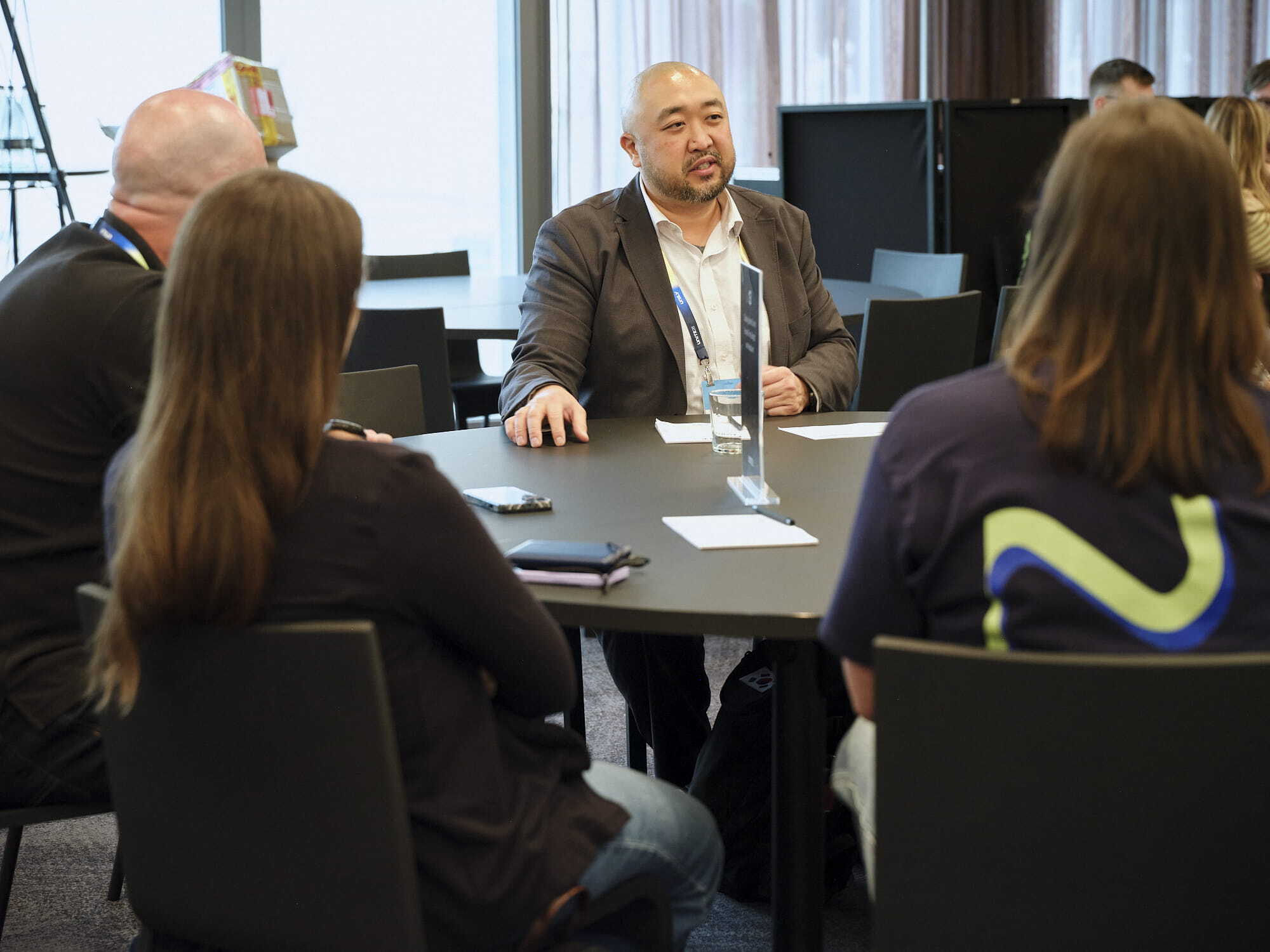
At Unite 26, some of the world's leading thinkers in AI, employee experience, communications, and organizational transformation came together with the people putting these ideas into practice. Across two days of conversations, a common message emerged: the future of work isn't simply a technology challenge. It's a human one.
From protecting employee attention to building trust in AI, sustaining change, and creating meaningful connections, seven powerful insights emerged about what organizations need to get right next.
1. Attention is Becoming One of an Organization's Most Valuable Resources
The cost of producing content has collapsed. The capacity of employees to consume it has not.
Digital workplace consultant and Co-Founder at Lithos Partners Sharon O'Dea pointed to Microsoft's Work Trend Index: the average person now receives 117 emails and 153 Teams messages, or 270 interruptions "all day long, every day."
AI has made it possible for almost anyone to add to that pile in minutes. As Sharon put it:
"AI has made content cheaper to produce, but it doesn't make anyone's day any longer."
Her argument wasn’t simply that organizations are communicating too much. It was that information overload is a design outcome. It's not a personal failing. When employees miss a message, the problem may not be their attention span or commitment. The channel may be wrong, the moment may be wrong, or the communication may not give them a compelling enough reason to care.
The more useful question isn’t, “How do we get employees to read more?” It’s “How do we get on the right side of the filter?”
That requires organizations to treat attention as a budget where every message is a withdrawal. Sharon did the math on a single CEO message to 40,000 people at 90 seconds each: "That's a thousand hours of attention in a single send." In any other circumstance, borrowing a thousand hours from teams like legal or engineering would require a business case.
At Dentsu, Laura Jennings, Sophie Muskett, and Neil Marshall showed what that discipline means in practice. Before using their digital workplace as a trusted foundation for AI, their team removed hundreds of outdated pages and redundant editors, simplified its taxonomy, and established clearer ownership. Their reasoning was straightforward: AI amplifies poor information just as readily as it amplifies good information.
In the future of work, producing more will be easy. Knowing what not to produce will be a competitive advantage.


2. AI Will Increase the Value of Human Judgment
Much of the conversation around AI still focuses on speed. But faster output is only valuable if people can judge its accuracy, relevance, and likely impact.
Internal communications advisor and CEO of The Curious Route Joanna Parsons questioned whether AI had fundamentally changed the communicator's job at all. Understanding the audience, knowing the business goals, connecting with leaders, and measuring the value of the work remains essential.
"The foundations of mastery of your craft will always be there and maybe aren't the bits that AI can help us [with]."
Fellow panelist Adib Abrahim, Managing Director of Brand Advertising, Digital, and Content at American Airlines, made a complementary point. AI lets communicators start from something other than a blank page, turning a day or two of drafting into a couple of hours. But the communicator still provides the context, subject-matter knowledge, and human perspective that makes a story meaningful. The time saved should go into asking whether the message will have the intended impact. "AI is an enabler of strategy," he said. "It's not a creator of strategy."
Laura Kennedy, Director of Team Member Communications at Life Time, put it even more plainly: "AI will never know your company and know your employees as well as you do."


During their live recording of Frequency, communications leaders Jenni Field and Chuck Gose highlighted judgment and curiosity as core skills for internal communicators. For Chuck, they’re the two ingredients for success with communicators using AI: curiosity to explore what it could help you do and judgment about what it produces. Their advice on volume was just as clear: work out what matters, then "do less but better."
AI can create options, accelerate production, and remove repetitive work. But it can't determine, without meaningful human direction, what an organization should say, why it matters, or what responsible action looks like.
As AI makes production easier, judgment becomes more valuable.
3. Trust Will Determine Whether AI Scales
The technical capability to deploy AI is advancing faster than many organizations' ability to build confidence around it.
At The Adecco Group, Niki Turner-Harding, Country Head for the UK and Ireland, and Sam Rope, Group Senior Vice President for HR Strategy and Transformation, shared research that exposed a significant readiness gap. While 70% of global leaders expected AI to significantly impact their organization within three years, only 50% felt their workforce was ready for that change.
Among workers interviewed, half expected the way they work to change significantly within five years, but less than half felt their organization was preparing them.
Adecco's response started with listening rather than technology. The team set up focus groups and sat down with colleagues to redesign how work gets done. It also recognized early that a productivity narrative would backfire, and the workforce would disengage with it. The focus moved to removing the repetitive tasks colleagues disliked, freeing time for judgment, creativity, and relationship-building.
The results backed up that choice. An AI-supported recruitment center has now handled more than 200,000 conversations, half of them outside working hours, which the team had always struggled to cover. "We haven't reduced one FTE through that center," Niki said. "It's a growth story. It's not a productivity story." Her advice to the room: "Listen before you launch."
Trust must also extend to the knowledge on which AI depends. The Dentsu team described intelligence as valuable only when it can be trusted. ASML reached the same conclusion when it rebuilt its intranet through content governance: Saskia Boeije, Global Channel Lead, and Janneke Reijnders, Senior Communications Manager, explained,
"Relevant and well-owned content strengthens our employee trust. It improves the search quality, but also it's a reliable foundation for AI."
Leaders play a part, too. Alexia Cambon described a Microsoft experiment in which a senior leader emailed every Monday about how they had used AI. "Every Tuesday we would see a 37% statistically significant bump in usage." Best-selling author Charlene Li explained why visible modeling matters in her keynote: "It makes it sanctioned, it makes it safe."
AI adoption isn’t simply a technology deployment. It’s a commitment to better information, clearer governance, meaningful employee involvement, visible leadership, and greater honesty about how work may change.


4. Transformation Doesn’t End at Launch
Organizations often talk about change as a program with a defined beginning and end. Allan Tanner, Digital Employee Experience Team Lead at Gallagher, challenged that assumption.
“You can’t just treat [transformation] as, ‘Here’s the start, here’s the finish.’ It’s, ‘Here’s the start, and then you have to keep going.’”
He had seen digital workplace initiatives regress after the initial funding, scrutiny, or enablement disappeared. The technology remained, but the practices that made it effective began to slide.
Charlene Li offered a useful frame for staying the course without standing still: "Your strategy written in ink, but your roadmap of how you're going to use AI must be written in pencil."
Tess Jennings, Senior Director at First Tech Federal Credit Union, offered a practical example from what she described as "the largest merger in credit union history in the United States," creating an organization with 2 million members and 3,500 employees. First Tech formed a cross-functional group of Change Champions from every team, explained the reasons behind upcoming changes, and enabled those volunteers to act as change agents within their teams. The organization featured them, so they were visible across the enterprise.
At Etihad Airways, Jill Weymes and Harvey Jefferson described a similar approach designed to last. Representatives from different employee groups were involved from the beginning, contributed feedback throughout testing, and remained champions after launch.
The lesson is straightforward: adoption isn’t an event. Organizations need structures that continue to reinforce, examine, and improve a change long after its launch campaign is over.


5. Personalization Must Begin With the Reality of People's Work
Personalization is often described as a content capability. In practice, it’s a recognition that employees do different jobs, in different environments, with different opportunities to engage.
Sharon O'Dea offered a simple test built on means, opportunity, and motive. Can the person physically receive the communication? Is there a moment in their day for it to land? Do they have a reason to care? "Anything that fails one of those tests isn't really a communication," she said. "It's just a record that you tried to communicate."
A theoretically accessible channel isn’t useful if it can't be used safely or practically during someone's working day. As Sharon pointed out, a field worker cannot use a tablet while in charge of a vehicle. And even when the opportunity exists, the content still has to be more relevant than everything else competing for their time.
This is particularly important for frontline employees.
Etihad Airways' workforce is around 75% frontline, mostly cabin crew and pilots, alongside engineers, warehouse managers, and core corporate teams. The ambition was to replace fragmented systems and one-size-fits-all communications with a seamless mobile experience. Personalization isn't a cosmetic feature. It’s necessary to make communication useful to people working in radically different contexts.
Marta Kobus, Head of Communication Channels and Impact at Schneider Electric, and Damini Singh, Communications Channel Owner, described a similar problem. Only 2% of employees were engaging with company communications on mobile because the journey required "many, many, many authentication steps." Their response focused on zero-touch deployment, one-touch login, and an app as simple to open as any other on employees' phones. It now supports more than 40 scopes and content in more than 30 languages, and engagement stands at 72%.
The future of employee experience won’t be won by delivering every message in every possible format. It’ll be won by understanding what employees need, when they need it, and how work actually happens around them.


6. Confidence is an Organizational Capability
The future of work will require employees and leaders to act without having every answer in advance. That makes confidence a strategic capability, but internal communications and confidence expert Advita Patel warned against confusing it with volume, certainty, or extroversion.
"It isn't about how loud you are, isn't about how extroverted you are, isn't about how certain you are. It's about trust."
More specifically, she described confidence as the trust in your abilities to be able to handle whatever life throws at you.
Research shared by Advita Patel found that the behaviors associated with confident leaders included advocating for others, being clear and decisive, and showing up authentically without a “corporate mask.” The behaviors people associated with confidence included standing up for their values, making decisions without constant validation, and being assertive in difficult conversations.
For communications and employee experience teams, confidence also means protecting employee attention, challenging poorly conceived requests, and making the case for work that will genuinely help people. As mountaineer Bonita Norris reminded the audience, it can be built: "Confidence is like a muscle. The more that you take small, everyday risks, the more your confidence will grow."
It’s difficult to lead through uncertainty if organizational culture rewards the appearance of certainty over honest, informed judgment.
7. Human Connection will Become More Valuable as Work Becomes more Automated
One of the clearest messages from Unite 26 was that greater automation doesn’t diminish the need for human connection. It heightens it.
Kim England, VP of Digital Employee Communications at Pearson, summed it up:
"Technology accelerates ideas, but it's human connection that really creates them."
She showed how conversations at previous Unite events had led to practical initiatives inside Pearson, following a repeatable pattern: conversation, action, and impact. Informal exchanges with peers became improvements to how the organization surfaced external brand content internally, used workplace screens, and brought more of the company's story into the employee experience. "AI can write, can analyze, it can automate," she said, "but human connection and people can connect, inspire, and collaborate."
For Chuck Gose, connection is also becoming a defining communications capability: connecting people to knowledge, connecting people to organizational values, and connecting people with one another.
This isn’t an argument against technology. It’s an argument for remembering what technology is supposed to enable. Charlene Li's challenge was to use AI "not to just do more work, but to use AI to be more human."
On the panel about building the intelligent digital workplace, Forrester principal analyst Cheryl McKinnon described digital employee experience as "that sum of all of those little things that add up during the course of the workday," from the hardware and software to the quality of information. The panel agreed that one of the clearest markers of an intelligent workplace is less stress: if organizations eliminate noise, take out complexity, and make answers easier to find, "we can just reduce stress for our employees."
An intelligent workplace should create more capacity for people to solve problems, exercise judgment, and build relationships, not simply allow an organization to generate more information at greater speed.
As routine work becomes easier to automate, the interactions people remember will increasingly be the ones that made them feel understood, supported, or connected to something larger than their immediate task.


The Future of Work is Still a Human Endeavor
The future of work will undoubtedly be shaped by AI. But what became clear over two days of conversation was that the organizations that benefit most won't necessarily be those that deploy the largest number of tools or generate the greatest volume of content.
They’ll be the organizations that protect attention, strengthen trust, sustain change, improve the quality of their knowledge, and give people the confidence to exercise judgment. Most importantly, they’ll use technology to improve the experience of work, rather than allowing the technology itself to become the experience.
The Voices Behind the Conversation
The seven truths in this article draw on ideas shared throughout Unite 26 by workplace and communications experts including Charlene Li, Sharon O'Dea, Alexia Cambon, Joanna Parsons, Jenni Field, Chuck Gose, Advita Patel, Allan Tanner, Cheryl McKinnon, and Bonita Norris.
They were joined by practitioners willing to share what transformation looks like inside their organizations, including Kim England of Pearson; Jill Weymes and Harvey Jefferson of Etihad Airways; Laura Jennings, Sophie Muskett, and Neil Marshall of Dentsu; Marta Kobus and Damini Singh of Schneider Electric; Niki Turner-Harding and Sam Rope of The Adecco Group; Tess Jennings of First Tech Federal Credit Union; Saskia Boeije and Janneke Reijnders at ASML; Laura Kennedy of Life Time Inc.; and Adib Abrahim of American Airlines.
Thank you to all our speakers!