

At Unite 25, Microsoft’s Sr. Product Manager, M365 Copilot Extensibility, Jane Koh, introduced the idea of “frontier firms” - organizations that go beyond deploying tools to “rethink how humans and intelligent agents work together.” This shift isn’t about technology alone. It’s about rethinking and rewiring how work gets done.
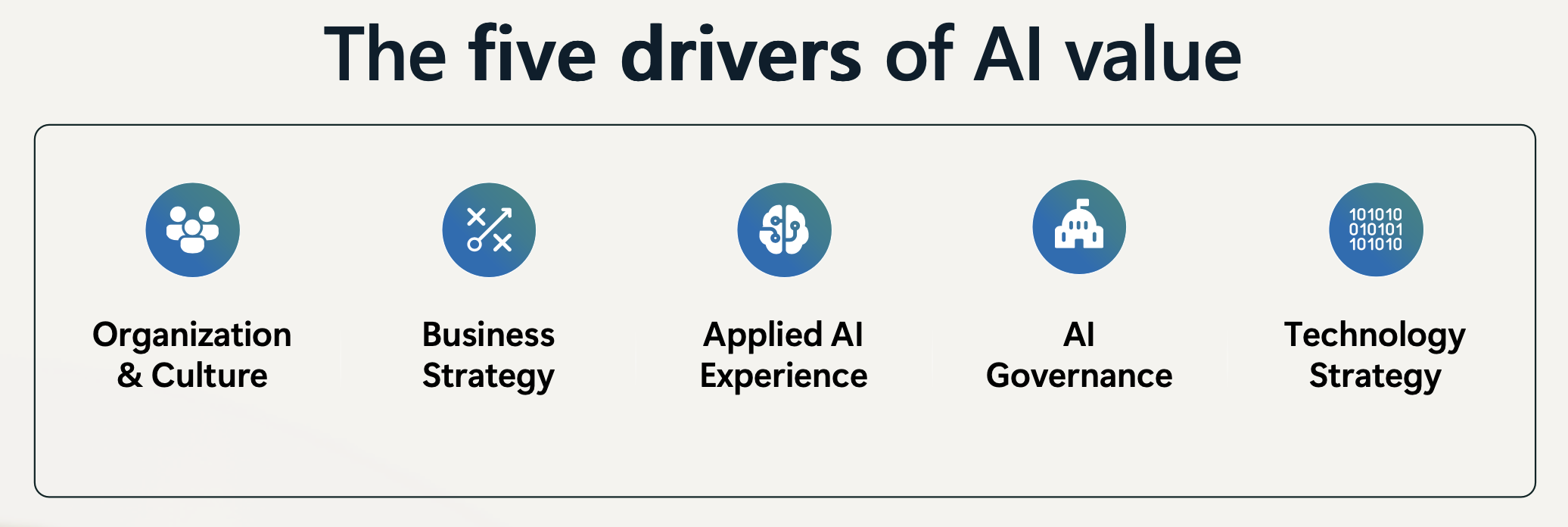
Microsoft’s framework highlights five drivers of AI value. For EX leaders, these drivers provide a practical roadmap to build trust, scale impact, and prepare the enterprise for the agent era.Here’s what you need to know:
1. Organization and culture: Build confidence, not compliance
The path to AI maturity begins with mindset. Technology may enable transformation, but culture determines whether it is destined to thrive or fail.
The most successful organizations don’t treat AI as an IT rollout, they make it a people movement. Because real transformation starts with people, not code. These enterprises cultivate AI curiosity: an environment where employees experiment, learn, and share outcomes openly.
Research by Microsoft reveals that 75% of knowledge workers already use AI at work, but only 38% say their organization has given them proper guidance on how to do so responsibly. This confidence gap is one of the biggest barriers to value realization and one of the biggest opportunities for EX leaders.
Employee experience teams are uniquely positioned to close that gap. Through storytelling, training, and transparent communication, they can shift perceptions from fear to empowerment. The message: AI isn’t replacing humans, it’s amplifying them.
“The goal isn’t to replace people; it’s to amplify them,” Jane explained to Unite 25 attendees, “Every employee becomes the manager of their own team of digital agents.”
When employees feel ownership over AI, they don’t just adopt it, they accelerate it. Culture becomes the engine of intelligent transformation.
2. Business strategy: Tie AI to outcomes that matter
AI without a purpose is just another project. Frontier firms succeed because they define the business outcomes AI is meant to drive. Then they measure relentlessly against them.
AI value isn’t abstract; it’s operational. It’s the 20 minutes saved per employee through automated responses. It’s the 30% faster resolution of HR tickets. It’s the higher engagement scores because employees spend less time navigating systems and more time doing meaningful work.
That’s why every AI initiative should start with three questions:
- What problem are we solving for the employee?
- How will this enhance productivity or experience?
- What will success look like in measurable terms?
Platforms like Unily help EX leaders answer these questions by connecting AI capabilities directly to business workflows. Whether it’s surfacing knowledge through Copilot, simplifying policy searches, or powering personalized communication, Unily translates AI potential into tangible value.
The frontier mindset isn’t about using AI everywhere - it’s about using it where it matters most.
3. Applied AI experience: Embed intelligence where work happens
The best AI doesn’t sit in a separate app, it shows up in the flow of work. Frontier firms focus less on introducing new tools and more on enhancing the ones people already trust.
This is where employee experience platforms become indispensable. Unily acts as the experience layer across Microsoft 365 and other enterprise systems, embedding intelligence into the daily routines of the workforce.
Imagine an onboarding journey where an AI agent inside your employee experience platform guides new hires to the right resources. Or an internal comms hub that automatically summarizes news for different audiences. Or a search bar that doesn’t just find documents but answers questions contextually.
That’s the power of applied AI: it removes friction rather than adds it. It doesn’t disrupt, instead, it integrates. And as employees experience AI working with them, not to them, adoption becomes organic.
When intelligence is seamlessly embedded, transformation becomes invisible, and effortless. It becomes unstoppable.
4. Governance: Make AI safe, responsible, and scalable
As AI evolves from assistants to autonomous agents, trust becomes the new currency. Without clear governance, even the most advanced tools can create risk, from misinformation to data leakage to ethical blind spots.
Frontier firms build governance into their DNA. They define transparent policies around data access, bias review, and accountability. They make it clear where human oversight begins and ends. Governance, in this sense, isn’t a brake on innovation, it’s the foundation that makes innovation safe to scale.
But governance also lives in the employee experience. Employees need to understand why rules exist, not just what they are. Through education and clear UX design, Unily helps organizations weave governance into daily workflows, enabling compliance without complexity.
This is where EX and IT intersect most powerfully: aligning human understanding with machine intelligence. The result? A culture of confidence, not caution.
5. Technology strategy: Connect the ecosystem
AI is only as powerful as the data it can reach. Yet many enterprises are still burdened by fragmented systems, data silos, redundant tools, and disconnected knowledge repositories.
The final driver of AI value is connectivity. Frontier firms invest in architectures that integrate, not isolate. They ensure data flows securely between systems, giving agents the context they need to act accurately and meaningfully.
Platforms like Unily sits at the center of this connected ecosystem. Its native integrations with Microsoft Copilot and other enterprise tools allow organizations to surface governed knowledge directly within AI-powered workflows.
That means when an employee asks a question, Copilot doesn’t just pull from general sources, it retrieves trusted, contextual answers from within Unily. The experience is unified, personalized, and compliant: the hallmarks of an intelligent organization.
Putting the Five Drivers into Practice
Each driver reinforces the next. Culture drives adoption. Strategy gives direction. Experience ensures usability. Governance builds trust. Technology enables scale.
Here’s how EX leaders can operationalize the model:
- Build a culture of AI literacy and open experimentation.
- Identify a few clear, high-impact use cases to prove early value.
- Embed intelligence into daily workflows rather than adding new tools.
- Establish governance early to build trust and accountability.
- Connect systems and people through a trusted, integrated experience layer.
As the Microsoft session emphasized at Unite 25, these drivers aren’t a checklist — they’re the foundation of what separates frontier firms from the rest. They enable organizations to move from scattered AI experiments to structured, human-led agent ecosystems. A series of orchestrated steps that turn curiosity into confidence and insight into impact.
The human-agent balance
The maturity of a frontier firm isn’t measured by how much AI it uses, but how effectively it balances automation with human oversight. Microsoft calls this the human–agent ratio, a new KPI for the intelligent enterprise.
The goal isn’t to maximize automation; it’s to optimize collaboration. The right balance frees humans to focus on creativity, empathy, and decision-making while agents take care of execution.
That’s the ultimate measure of progress: not technology for its own sake, but technology in service of human potential.
Interested in learning more about how Unily can support you in unlocking the potential of AI for employee experience transformation? Speak to one of our digital employee experience experts today.
Get started. Get your personalized demo.