
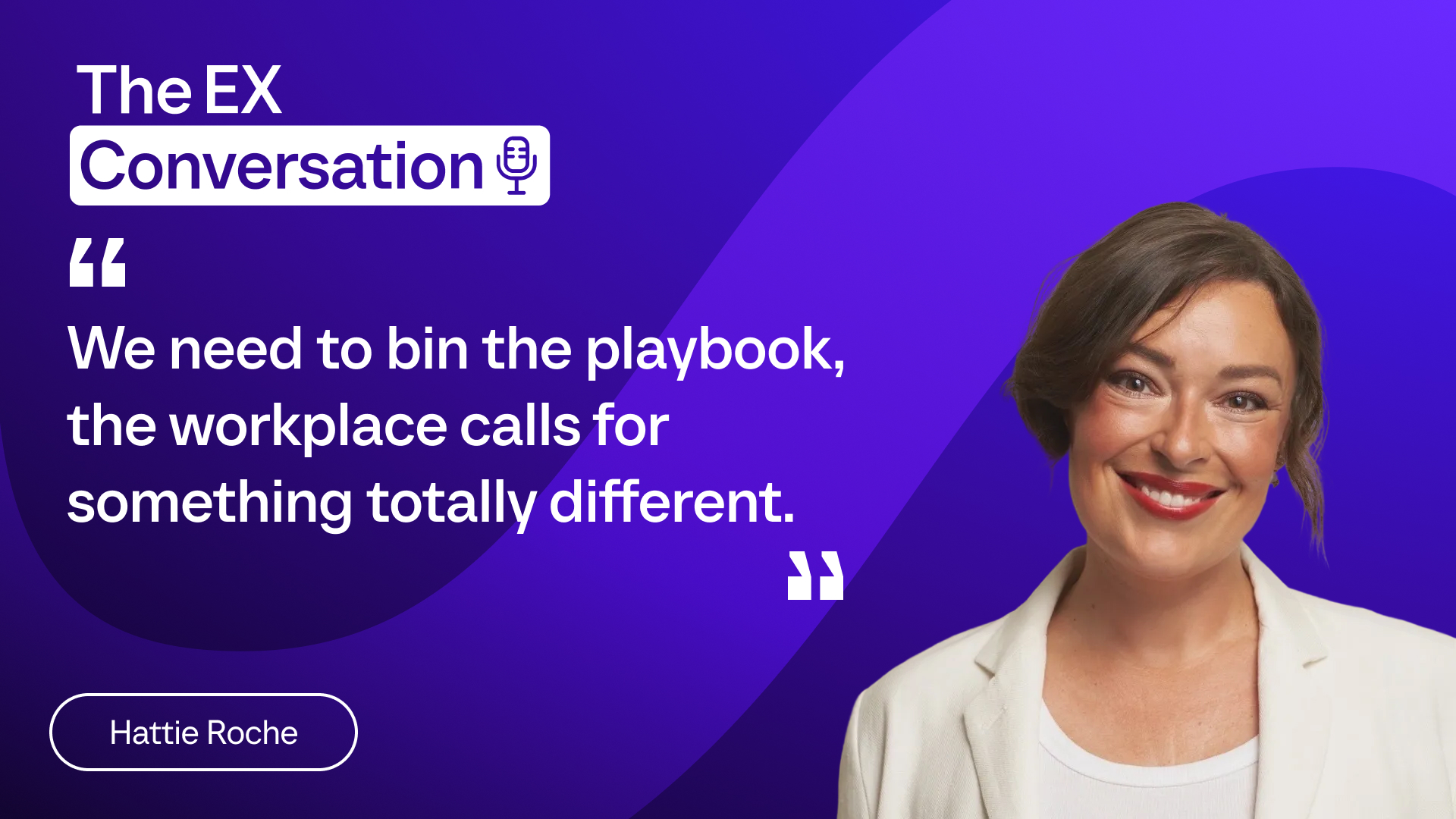
In a recent episode of The EX Conversation, Hattie Roche - employee experience leader and agency founder with a background spanning the BBC and advisory work across complex organizations - offered a grounded perspective shaped by both professional experience and personal reality. Her message was direct: the systems we’ve inherited weren’t designed for the complexity people actually live and work in today.
Here are three takeaways that challenge some of EX’s most persistent assumptions.
1. The systems we rely on weren’t designed for real human lives
Most EX leaders know this instinctively. Policies, programs, and lifecycle frameworks look comprehensive on paper - but they often fall short when employees need them most.
Hattie experienced this gap firsthand after a cancer diagnosis early in her career. She found herself supported by people, but constrained by the systems meant to support her.
“Policies, structures, the formulas of which we build our workplace experience, they fundamentally don't work for anything outside of the ordinary… A sick policy doesn't cover six months of chemo.”
This isn’t a criticism of individual policies. It’s a recognition that most organizational systems were built around predictability and standardization. But human lives are neither predictable nor standardized.
Her conclusion was stark:
“We need to almost bin the playbook. It is irrelevant how we've always done things.”
For EX leaders, this reframes the job. It’s not about refining existing systems endlessly. It’s about questioning whether those systems reflect the reality employees actually experience.
That often means shifting from designing processes for efficiency to designing systems for adaptability -ones that can flex when life inevitably deviates from the “expected” path.
Episode 2: Why it’s time to rethink the EX playbook

2. Psychological safety isn’t a leadership concept, it’s a system design problem
Psychological safety is widely discussed, but often narrowly interpreted as a leadership behavior—something developed through training programs or leadership frameworks.
Hattie challenges that assumption. For her, psychological safety is embedded in the infrastructure of everyday work.
“The ability to be myself, speak up when things are going well or poorly without fear of blame or retribution.”
That doesn’t come from a single workshop. It comes from how performance is managed, how feedback happens, how recognition works, and how decisions are made.
She points to the traditional annual performance review as a good example of how systems can unintentionally undermine safety:
“Why are we spending one year to tell somebody that they're on fire?… Why would we make somebody feel safe if all of that growth and feedback and conversation about development is fit within a tiny little box?”
When feedback is infrequent, formalized, and high-stakes, it discourages openness rather than encouraging it.
Instead, Hattie advocates for systems that normalize ongoing dialogue—supported by infrastructure, not left to individual leadership capability alone.
That might include technology prompts for regular check-ins, simpler feedback loops, or redesigning performance management entirely around continuous conversations rather than annual events.
The key shift is this: psychological safety isn’t something leaders create alone. It’s something organizational systems either enable or prevent.
3) EX leaders don’t need more data, they need to listen differently
Most organizations aren’t short on employee data. They have engagement surveys, pulse surveys, and dashboards tracking sentiment.
But Hattie argues that traditional listening approaches often miss the point.
“Employee survey fundamentally [doesn’t work]. It’s a moment in time. Listening needs to be broadened.”
The real opportunity lies in treating employees not just as respondents, but as contributors to solutions.
She challenges a persistent assumption—that leaders are best positioned to design organizational improvements.
“The people closest to the challenge have the best answers.”
This is particularly relevant in complex organizations, where frontline realities are often invisible to senior leadership.
Technology has made it possible to scale listening in ways that weren’t feasible before—not just collecting feedback, but enabling genuine co-creation.
But Hattie is clear that listening alone isn’t enough. The signal it sends matters just as much:
“It’s an amazing signal to be able to say this organization cares about your voice… that it is a safe place for you to be able to have any idea that you like.”
This isn’t about collecting more input. It’s about shifting from consultation to shared ownership of improvement.
Why this matters
Many EX leaders feel caught between rising expectations and inherited systems that weren’t designed to meet them. Hattie’s perspective offers a practical way forward - not by waiting for perfect models, but by rethinking foundational assumptions.
This approach helps EX leaders move forward even without perfect clarity. It replaces the pressure to implement the “right” framework with the responsibility to design systems that reflect real human complexity.
And perhaps most importantly, it reinforces that employee experience isn’t separate from business performance. As Hattie put it:
“Why would we not create environments that enable people to do their best work?”
That question reframes EX not as a support function, but as a core driver of organizational capability.
Want the full conversation?
This article captures just a few of the insights from Hattie Roche’s conversation on The EX Conversation. In the full episode, she also explores how to simplify employee experience, why co-design matters more than best practice, and what EX leaders should prioritize developing in themselves.
If this resonated, it’s worth listening to the full conversation to hear the nuance behind these ideas—and how one EX leader is navigating the reality of redesigning work in real time.
Get started. Get your personalized demo.