
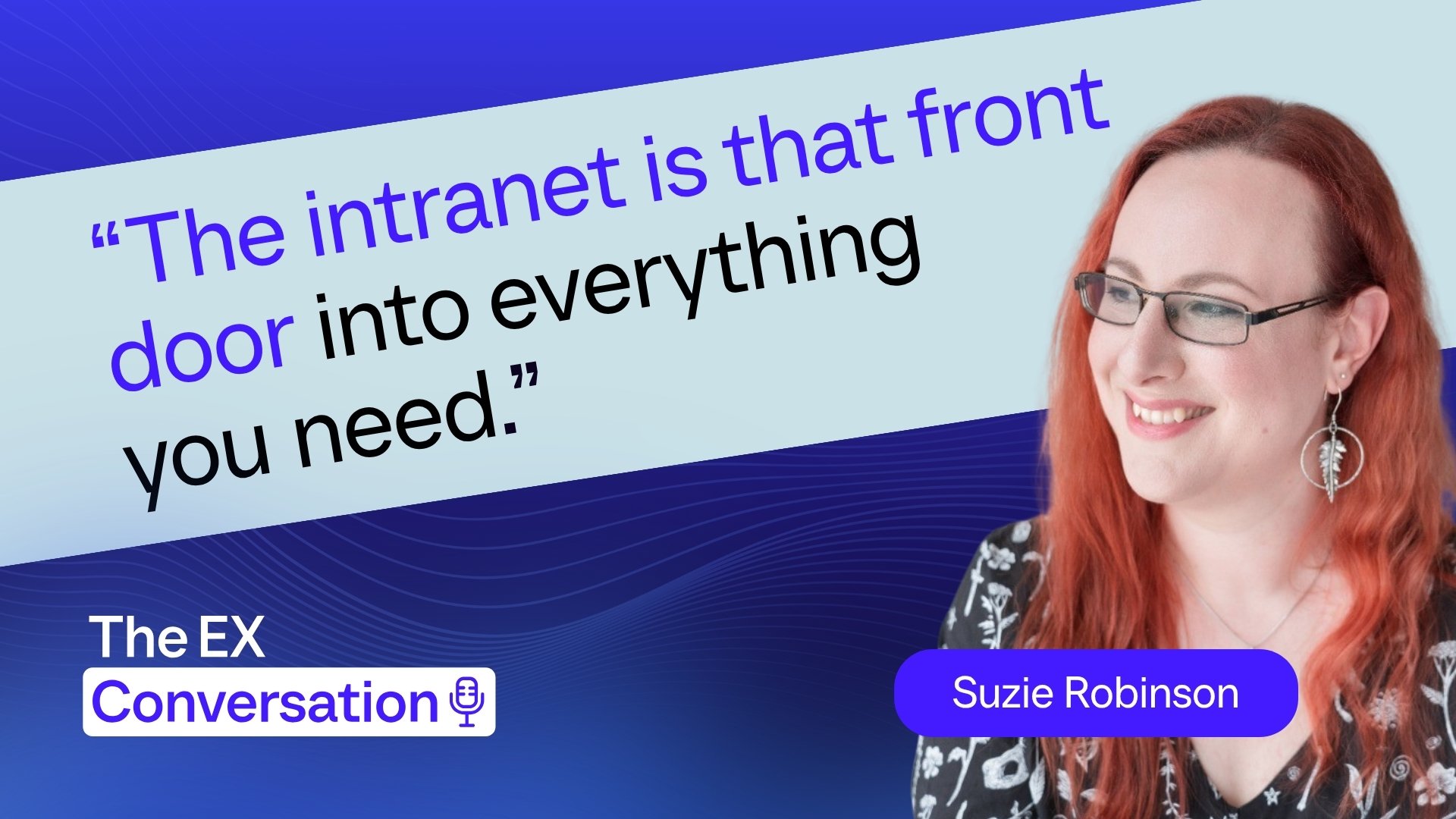
In a recent episode of The EX Conversation, Suzie Robinson shared a grounded, practitioner-led perspective shaped by years working across internal comms, intranets, and consulting. Her experience cuts through the noise: what matters isn’t the platform itself, but how people think about using it.
Here are three takeaways that stand out for EX leaders navigating that complexity.
1. You don’t have an intranet problem — you have a thinking problem
For many organizations, intranets are still judged based on outdated assumptions: clunky tools, poor usability, and content nobody reads. That legacy perception quietly shapes decisions today.
As Suzie puts it:
“That vision is what some people may still have in their mind when they think intranet… but the reality is that technology has evolved.”
The issue isn’t just technology — it’s how leaders frame the role of the intranet in the first place.
Suzie’s reframing is simple but powerful: the intranet isn’t a destination, it’s a facilitator.
It exists to help employees do their jobs better — not to compete with other systems or “own” workflows.
In practice, this shifts decision-making:
- Instead of asking “Which platform is best?”, ask “Where are the gaps in how work actually happens?”
- Instead of trying to replace everything, focus on connecting what already exists
- Instead of designing for features, design for real employee journeys
This is especially relevant as terminology evolves. Whether it’s called an intranet, digital workplace, or EX platform doesn’t matter — what matters is whether it reduces friction in everyday work.
2. There is no “best” solution — only better-fit trade-offs
EX leaders are often pushed — implicitly or explicitly — toward comparison thinking: rankings, scores, and “top platforms.” It creates the illusion that the right answer exists somewhere out there.
Suzie is clear that this mindset is flawed:
“There is no one best platform… it is whatever is best for the individual client.”
In reality, every decision is a trade-off shaped by constraints:
- Budget limitations
- Technical capability
- Workforce composition (frontline vs. desk-based)
- Organizational maturity
What experienced practitioners do differently is accept those constraints early — and design within them, not against them.
Suzie’s approach at Clearbox reflects this: evaluate platforms against consistent criteria, but interpret results through the lens of context. A lower-scoring tool might still be the right choice if it solves the most important problem well.
For EX leaders, this is a shift from optimization to fit:
- Stop chasing completeness — prioritize relevance
- Accept that strengths in one area often mean compromises in another
- Make decisions you can explain clearly, not just justify with data
This is also why external benchmarks can only take you so far. They inform thinking, but they don’t replace judgment.
Episode 8: How to make better intranet decisions in a complex EX landscape with Suzie Robinson

3. AI won’t fix your EX foundation — it will expose it
AI is dominating EX conversations right now — but Suzie’s perspective is notably pragmatic.
“There’s a huge opportunity… but a lot of what needs to happen is based around humans doing things.”
The uncomfortable truth: AI effectiveness depends on the quality of what already exists.
If your content is outdated, your governance unclear, or your ownership fragmented, AI will amplify those problems — not solve them.
Suzie points to governance as the critical (and often neglected) foundation:
- Clear ownership of content and processes
- Ongoing maintenance, not one-off cleanups
- Structured, reliable information that AI can trust
And yet:
“Governance is not a sexy part of intranet management… it can lead to it being forgotten about.”
This is where experienced EX leaders need to push back on the “shiny object” trap.
In practice, this means:
- Treating governance as an operational discipline, not a document
- Simplifying processes so they’re actually used
- Embedding content quality into everyday workflows
Suzie also highlights a practical mindset shift: governance doesn’t need to be a 100-page rulebook. It needs to be usable, visible, and sustained over time.
AI is a multiplier — but only for organizations that have done the groundwork.
Why this matters
Across all three takeaways, there’s a consistent theme: EX leadership is less about having the right answers, and more about asking better questions.
Suzie’s thinking helps reframe common challenges:
- You don’t need perfect data or a perfect platform to move forward
- You do need clarity on what problem you’re solving — and for whom
- You need to be comfortable making decisions with trade-offs, not absolutes
This approach also makes it easier to communicate with senior stakeholders:
- Focus on outcomes, not tools
- Explain decisions in terms of constraints and priorities
- Show progress through improved experience, not just new features
In a space that often leans toward overcomplication, this is a more grounded, realistic way to lead.
Want the full conversation?
If this resonated, it’s worth going deeper. The full episode of The EX Conversation with Suzie Robinson explores additional themes around storytelling, governance, and the evolving role of intranets in the digital workplace.
Sometimes the most useful insights aren’t new — they’re the ones that help you see familiar problems more clearly.
Get started. Get your personalized demo.