
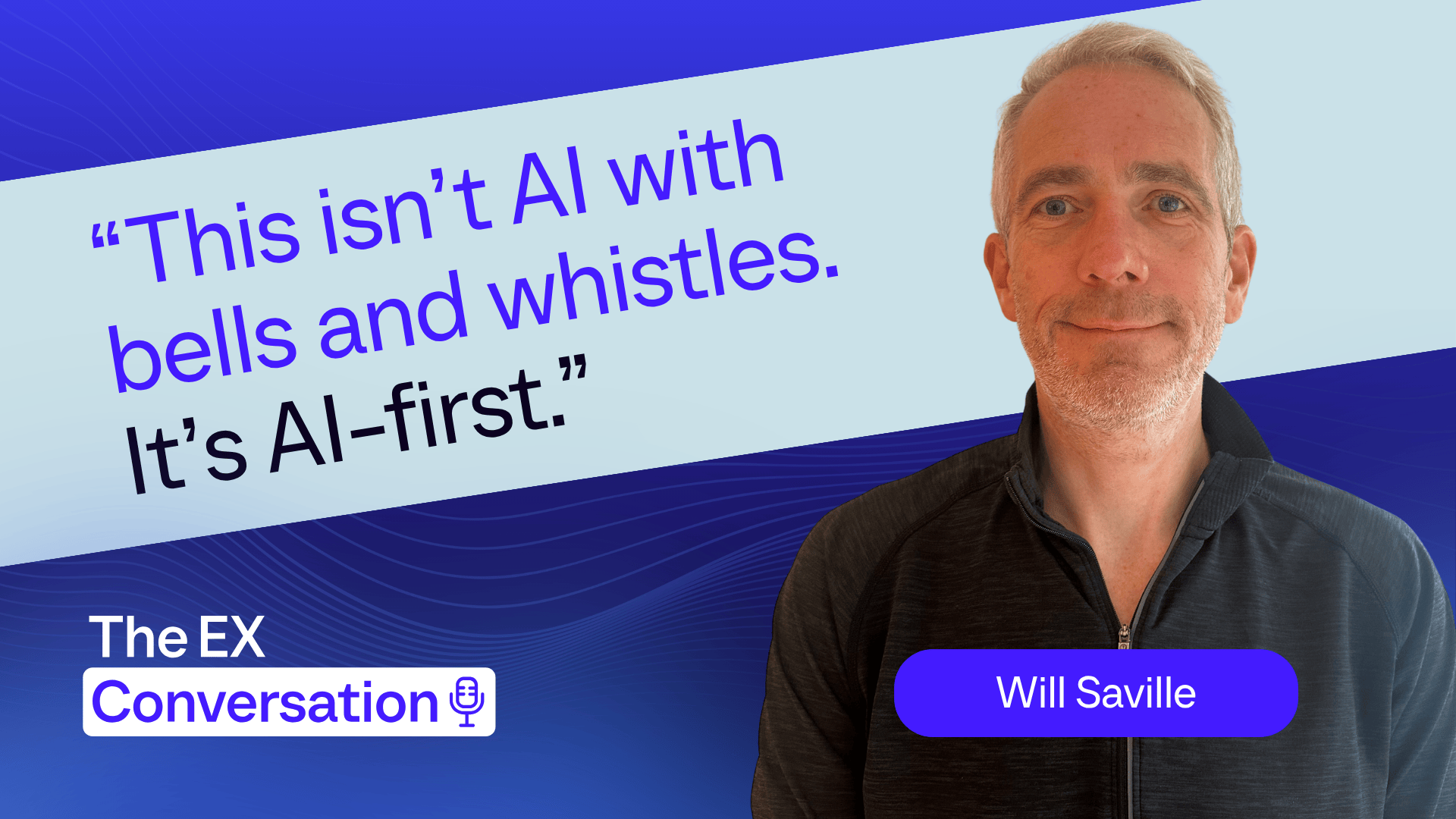
In a recent episode of The EX Conversation, Will Saville, co-founder of Unily, shared a perspective grounded in nearly two decades of building intranet and employee experience platforms. His focus wasn’t on AI as a trend, but on what an AI-native approach really demands from EX teams.
Here are three takeaways that stand out.
1. AI-native EX starts with a mindset shift—not a feature set
Many organizations are still approaching AI as something to “add on” to existing platforms. A few automation features here, a content assistant there. But Saville is clear that this approach misses the point.
“It’s really about building AI into the core of the product rather than just sprinkling it around the outside.”
The underlying problem for EX leaders is familiar: legacy ways of working are deeply embedded. Processes, content structures, and even team roles are built around assumptions that no longer hold.
An AI-native approach forces a different starting point:
- What if content creation isn’t the bottleneck anymore?
- What if building pages or campaigns isn’t where time should be spent?
- What if systems can iterate and improve outputs on their own?
Saville describes moving away from “one-shot” outputs toward systems that loop and refine until the task is complete. That’s a fundamentally different model of work.
In practice, this means EX leaders need to rethink not just tools—but how work is structured:
- Less time on production
- More time on judgment, prioritization, and quality
- A shift from doing → directing
AI-native EX isn’t about doing the same things faster. It’s about deciding which things humans should still be doing at all.
2. The real opportunity isn’t more content—it’s better ways to deliver it
If there’s one area where AI-native thinking is already changing EX, it’s content.
Most organizations aren’t struggling to create information. They’re struggling to make it usable. Long documents, static pages, and one-size-fits-all messaging still dominate—despite how people actually consume content outside of work.
Saville draws a sharp contrast:
“They’re not posting a hundred page PDFs… because they know they need to market to their audience.”
The problem EX leaders experience is clear: employees don’t engage—not because they don’t care, but because the format doesn’t work.
AI changes the constraint.
“It’s about being able to provide that content in multi-formats… if people want to consume a piece of content as a video or a podcast… they can do it.”
This idea of “liquid content” is central to AI-native EX. The same source material can be transformed into:
- Short-form summaries
- Video or audio formats
- Visual explainers
- Personalized variations
The shift here is subtle but important. It’s not about producing more content—it’s about making existing content adaptable and accessible.
For EX leaders, this changes the conversation internally:
- From “how do we create more?”
- To “how do we make what we have actually usable?”
And critically, it allows teams to spend less time reformatting and more time deciding what matters and how to position it.
Episode 7: From Intranets to AI-First EX — A Conversation with Unily Founder Will Saville

3. In an AI-native world, waiting for certainty is the biggest risk
AI is moving faster than most organizations can comfortably absorb. That creates a familiar tension: leaders want to be thoughtful and responsible—but also don’t want to fall behind.
Saville’s approach leans toward action over hesitation:
“It was almost like, okay, I’ve got this idea, let’s just do it… it’s the only way we’re going to find out whether it’s going to work or not.”
The problem for EX leaders is that traditional decision-making models—based on validation, benchmarking, and consensus—don’t work well in this environment. There often isn’t a proven path to follow.
Saville also highlights the importance of engaging directly with the technology:
“It’s best to understand that type of technology rather than to ignore it.”
In practice, this means:
- Experimenting before you have a full strategy
- Learning by doing, not just observing
- Accepting that some initiatives won’t land
This isn’t about reckless innovation. It’s about recognizing that inaction carries its own risk—especially when the pace of change is this high.
For EX teams, small, contained experiments can go a long way:
- Testing AI-assisted content workflows
- Piloting new formats for a single campaign
- Exploring how knowledge can be surfaced differently
The goal isn’t to get it perfect. It’s to build understanding—and momentum.
Why this matters
AI-native EX isn’t a future concept. It’s already reshaping how work gets done—and exposing where current approaches fall short.
What Saville’s perspective offers is a more grounded way to respond:
- Start with mindset, not features. Rethink how work should be structured before layering in technology.
- Focus on delivery, not volume. The value of content is determined by how it’s consumed, not how much exists.
- Act without perfect certainty. Progress comes from experimentation, not waiting for clarity that may never come.
For EX leaders, this way of thinking helps cut through the noise. It makes it easier to move forward, communicate decisions with confidence, and focus on what will actually improve the employee experience today—not someday.
Want the full conversation?
This conversation with Will Saville is part of The EX Conversation series, where practitioners share how they’re navigating the realities of employee experience in real time.
If this perspective resonated, it’s worth spending time with the full episode. There are additional insights on AI, product thinking, and the evolving role of internal comms that add important depth—and reflect the kind of trade-offs most EX leaders are actively working through right now.
Get started. Get your personalized demo.