
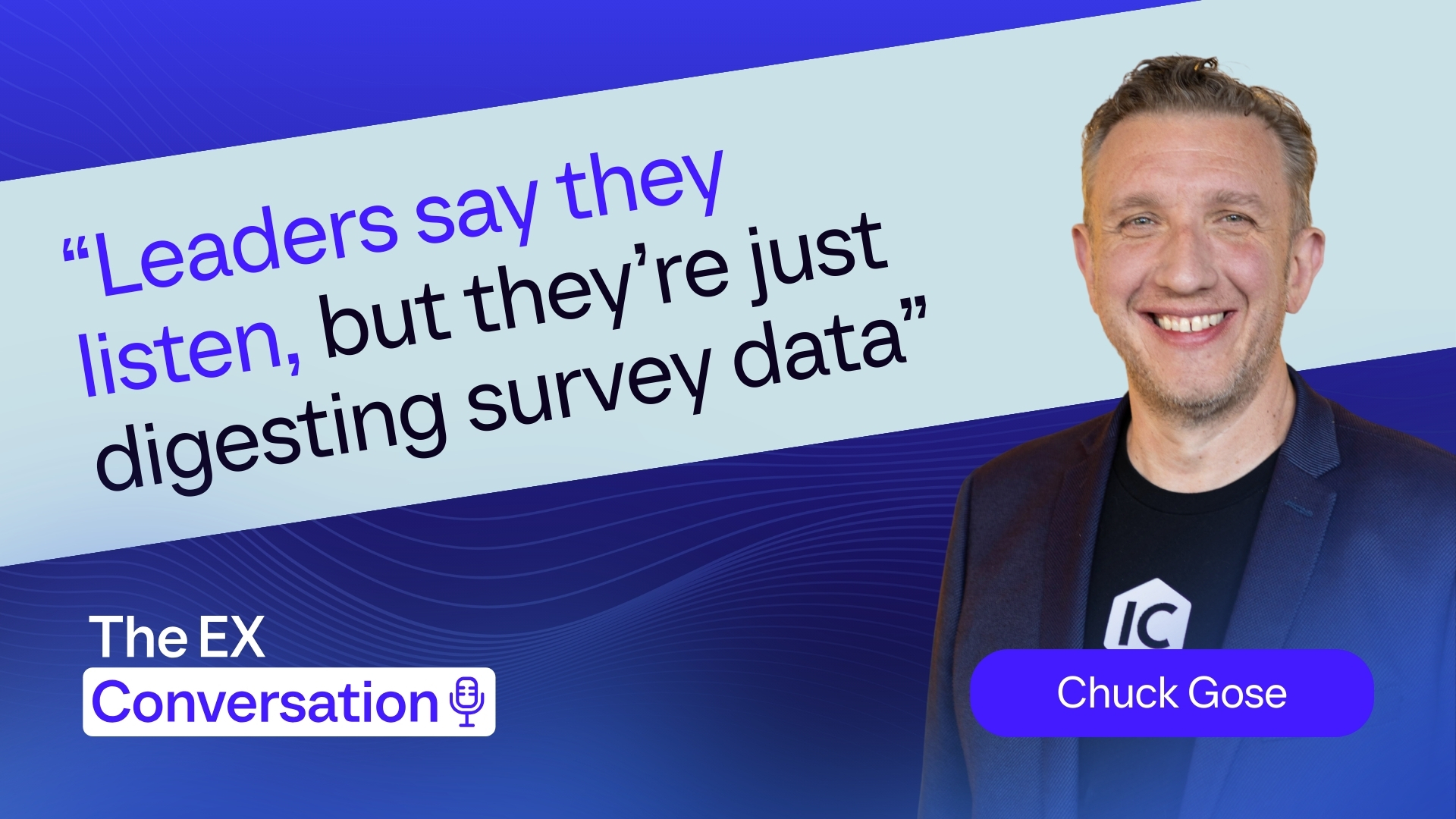
In a recent episode of The EX Conversation, Chuck Gose—founder of ICology and longtime internal comms leader—offered a grounded, experience-led perspective on what’s actually working. Having spent years both inside organizations like General Motors and Rolls-Royce and now running a global comms community, his lens is practical, not theoretical.
What stands out isn’t a new framework or tool. It’s a shift in how EX leaders think about listening, leadership, and where to focus their energy.
1. You’re probably measuring listening—but missing it entirely
Most organizations would say they’re good at employee listening. They run surveys, pulse checks, and focus groups. But Chuck challenges whether that’s actually listening—or just structured data collection.
As he puts it:
“Are they really listening? Are they just asking questions… what are they doing with it?”
The issue isn’t that surveys are wrong. It’s that they’re incomplete. They represent a “push” model—organizations deciding when and how employees can speak.
Chuck’s focus is on the signals that happen outside those systems:
- Are employees referring friends to work here?
- Are they taking time off—or avoiding it?
- What does absenteeism or presenteeism look like?
- How do behaviors shift over time?
“What are all the different signals that employees are putting out there that they’re not even aware of?”
In practice, this changes the role of EX leaders. It’s less about launching new listening programs and more about interpreting what’s already happening.
That requires closer partnership with HR, operations, and even finance—not more tools.
2. Leaders say they listen. Their behavior tells a different story
There’s a consistent gap Chuck sees across organizations: leaders who talk about listening but don’t demonstrate it in ways employees trust.
“They might say, yes, we listen to employees, but really all they’re doing is digesting some data points from a survey.”
Real listening is messier. It involves:
- Spending time where work actually happens
- Creating space for employees to speak honestly
- Acting on what’s heard—and showing that you have
Chuck’s own approach was simple but telling. While working in manufacturing, he moved his office onto the factory floor to stay close to frontline employees.
“I would much rather be closer to the larger percentage of frontline employees than in the offices.”
There’s also a deeper dynamic at play: power.
Even when leaders do show up, employees may not feel safe being candid. The hierarchy itself can distort what gets shared.
That’s why listening isn’t just about access. It’s about reducing the barriers that come with status and authority—and recognizing that not all voices are equally easy to hear.
And importantly, this doesn’t stop at the frontline. Chuck calls out a group often overlooked:
Middle managers.
They’re translating strategy downward and pressure upward, yet often feel the least heard in the system.
Episode 5: Are we really listening? Community, the frontline, and what gets missed with Chuck Gose

3. Stop chasing influence. Start focusing on impact
Few topics come up more in internal comms than “getting a seat at the table.” Chuck’s view is blunt:
“Let’s stop complaining about this seat at the table nonsense.”
For many EX leaders, this hits a nerve. But the point isn’t dismissive—it’s pragmatic.
Where comms sits structurally matters less than how it shows up operationally.
“You’re never going to control where you report… it’s more the personality of who you report to.”
In other words, influence isn’t granted by org charts. It’s built through:
- Consistent decision support
- Clear interpretation of what’s happening in the business
- Credibility with leaders based on outcomes, not positioning
There’s a similar realism in how Chuck frames the purpose of EX itself. When asked whether EX exists for employees or the business, his answer is direct:
“If things aren’t good for the business, they’re not going to be good for employees.”
That’s not about prioritizing profit over people. It’s about recognizing the dependency between the two—and making decisions in that context.
Why this matters
What Chuck is really pointing to is a shift in where EX leaders place their attention. It’s easy to focus on building new programs, chasing visibility, or trying to perfect the narrative—but the work that actually moves things forward is quieter and more grounded. It’s about reading the signals already in the system, helping leaders see what’s really happening, and making practical decisions with imperfect information. That’s what builds credibility over time. And in an environment where change is constant and pressure is high, that ability—to interpret, to simplify, and to act—is far more valuable than having the perfect data set or the ideal seat at the table.
Want the full conversation?
This blog captures just a slice of the conversation. There’s more in the full episode—from Chuck’s views on AI and creativity to how community shapes the future of comms.
If this resonated, it’s worth spending time with the full discussion from The EX Conversation to hear the nuance behind these ideas.
Get started. Get your personalized demo.