
That challenge is familiar to many professionals navigating corporate environments today. Employee experience leaders talk frequently about culture, inclusion, and belonging, but the lived reality of progressing through organisations can still feel very different depending on who you are and how you're perceived.
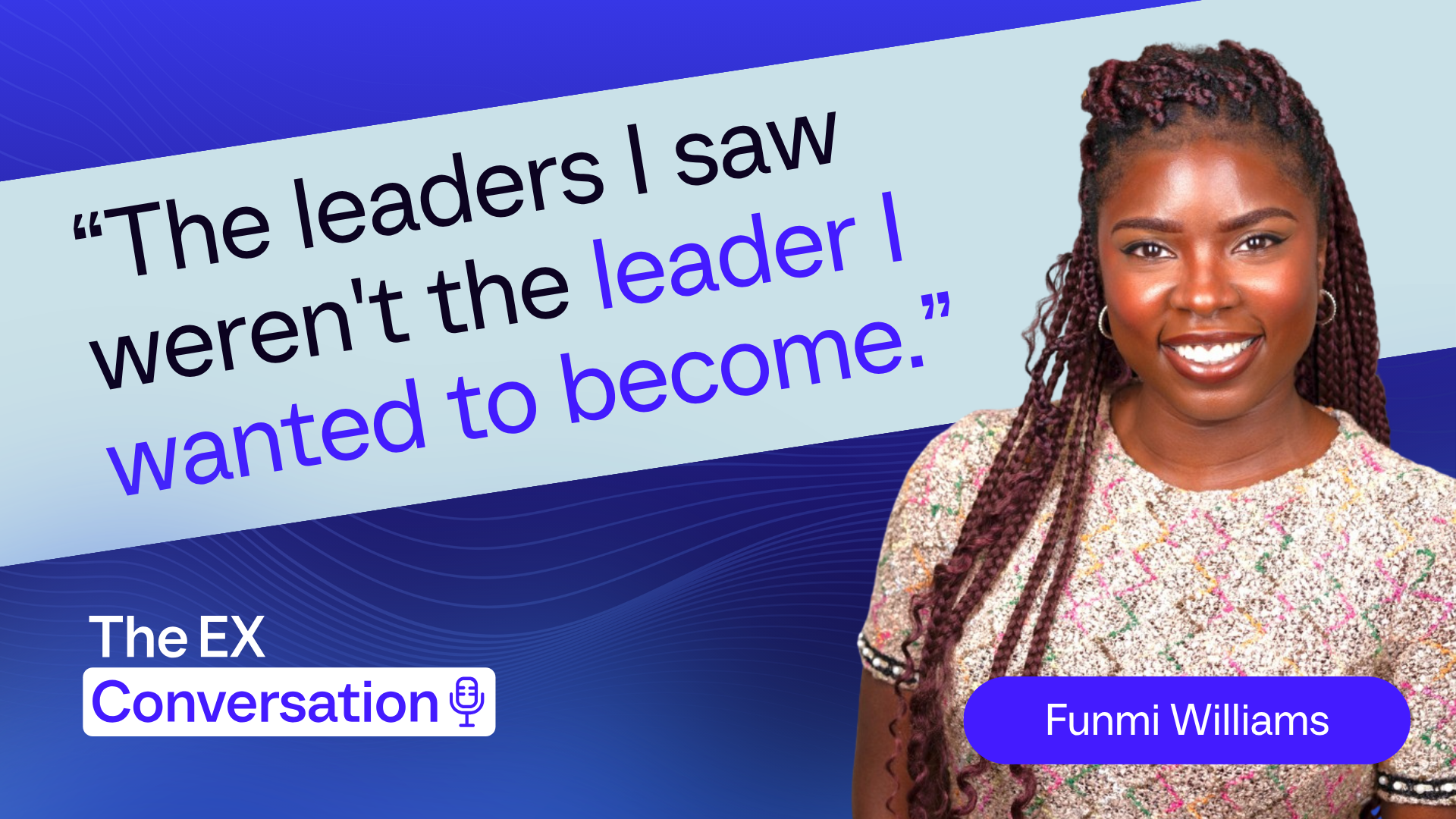
In a recent episode of The EX Conversation, Kaz Hassan spoke with Funmi Williams, Head of Internal Communications at AND-E. Drawing on a career spanning organisations including HSBC, Amazon, CBRE, JLL and Kantar, Funmi shared candid reflections on leadership, identity, resilience, and the role internal communicators can play in creating more inclusive workplaces.
Here are three takeaways that stood out.
1. When existing leadership models don’t fit, build your own
Many leadership conversations focus on finding role models. But for some people, the challenge is that the available examples either don’t exist or don’t represent the kind of leader they want to become.
Funmi reflected on progressing through corporate environments where she often found herself unlike those in senior positions around her.
“I really put work and effort into understanding what kind of leader I want to be, what kind of leader I want to be.”
Rather than trying to replicate leadership styles that didn't resonate, she intentionally defined her own approach. That meant being clear about her values, understanding what behaviours she wanted to embody, and resisting the pressure to become a version of leadership she didn't respect.
Importantly, this wasn't just about career progression. It was about recognising that leadership isn't a fixed template. Different leaders create different environments, and the responsibility isn't simply to adapt to existing systems but to actively shape new ones.
For EX leaders, that's an important reminder. Leadership development often focuses on competencies and behaviours, but identity matters too. When people feel they must abandon parts of themselves to succeed, organisations lose unique perspectives. The stronger approach is helping people develop confidence in their own leadership style while giving them room to evolve it over time.
As Funmi put it:
“I lead my teams the way that I would have wished I was being led myself.”
2. Adaptability is powerful—but it comes with a cost
Employee experience professionals spend a lot of time helping employees navigate change. Less attention is paid to the invisible work many people do every day simply to navigate workplace expectations.
Throughout the conversation, Funmi spoke openly about adapting her communication style, personality, and behaviour to fit different environments. Sometimes that adaptability helped her succeed. Other times it became exhausting.
Reflecting on earlier experiences in her career, she described the pressure to constantly manage how she was perceived:
“There was always a part of my brain that was kind of sectioned off to make sure I was behaving the way that was expected of me.”
Like many professionals from underrepresented backgrounds, she described experiences of code-switching, masking aspects of her personality, and navigating assumptions about traits such as ambition, energy, and assertiveness.
What's striking is that none of this had anything to do with capability. The challenge wasn't whether she could do the job. The challenge was navigating the expectations attached to how she showed up at work.
At the same time, Funmi doesn't frame adaptability as purely negative. Over time, she came to view it as a strength.
“I've learned to kind of be really, really adaptable. I've learned to build up a lot of resilience.”
For communicators, this highlights an important tension. Adaptability helps people succeed, but organisations shouldn't rely on individuals doing all the work. EX teams should be asking whether employees are adapting because they're growing—or because they feel they have no other choice.
The difference matters.
Episode 20: Finding Your Voice at Work: Leadership, Inclusion, and Authenticity with Funmi Williams

3. Better communication starts with better listening
When the conversation turned to practical actions organisations can take, Funmi's advice was refreshingly uncomplicated.
Listen.
Not just to leadership teams. Not just through annual surveys. And not just to the loudest voices in the room.
“Creating opportunities for listening exercises to your people because you're going to get the best real information from that.”
It's a principle most communicators already understand, yet many organisations still struggle to put it into practice consistently. Leaders often believe they understand employee needs, but frontline experiences can tell a very different story.
For Funmi, listening isn't simply data collection. It's a way to uncover the nuances that broad organisational strategies often miss.
She pointed to a recent benefits platform launch as an example. Rather than pushing a single message to everyone, her team considered the different audiences engaging with the same programme.
A message about pensions might resonate with one group. Financial advice might be more relevant to another. The core offering remains the same, but the communication reflects different needs and contexts.
That mindset extends far beyond benefits communications. It's about recognising that employees don't experience the workplace in identical ways, even when they work for the same organisation.
As she explained:
“It's about thinking about the different people every time that we're communicating.”
For internal communicators, this is where inclusion becomes tangible. Not through statements or campaigns, but through everyday decisions about who is considered, who is represented, and whose needs are reflected in communications.
Why this matters
One of the most valuable aspects of Funmi's perspective is that she doesn't present leadership, inclusion, or communication as problems that can be fully solved.
Instead, she talks about navigating complexity.
That means recognising that not every workplace will be the right fit. It means understanding that resilience is important, but so is creating environments where people don't need to constantly prove themselves. And it means accepting that inclusion isn't something you declare—it's something you build through hundreds of small decisions over time.
For EX leaders, that kind of thinking is useful because it reflects reality.
The goal isn't perfect data, perfect leadership, or perfect communication. The goal is making better decisions with the information you have, listening more carefully, and creating environments where more people can thrive without having to leave parts of themselves at the door.
That's a far more practical and achievable ambition.
Want the full conversation?
This article only scratches the surface of the conversation. Funmi also shares more about career progression, navigating corporate environments, building resilience, sponsorship, mentorship, and creating opportunities for underrepresented talent.
If these themes resonated, it's worth listening to the full episode of The EX Conversation to hear the broader context, nuance, and lived experiences behind the insights explored here.
Get started. Get your personalized demo.