
For internal comms leaders, that raises an uncomfortable question: if AI can take on more of the work, what’s left?
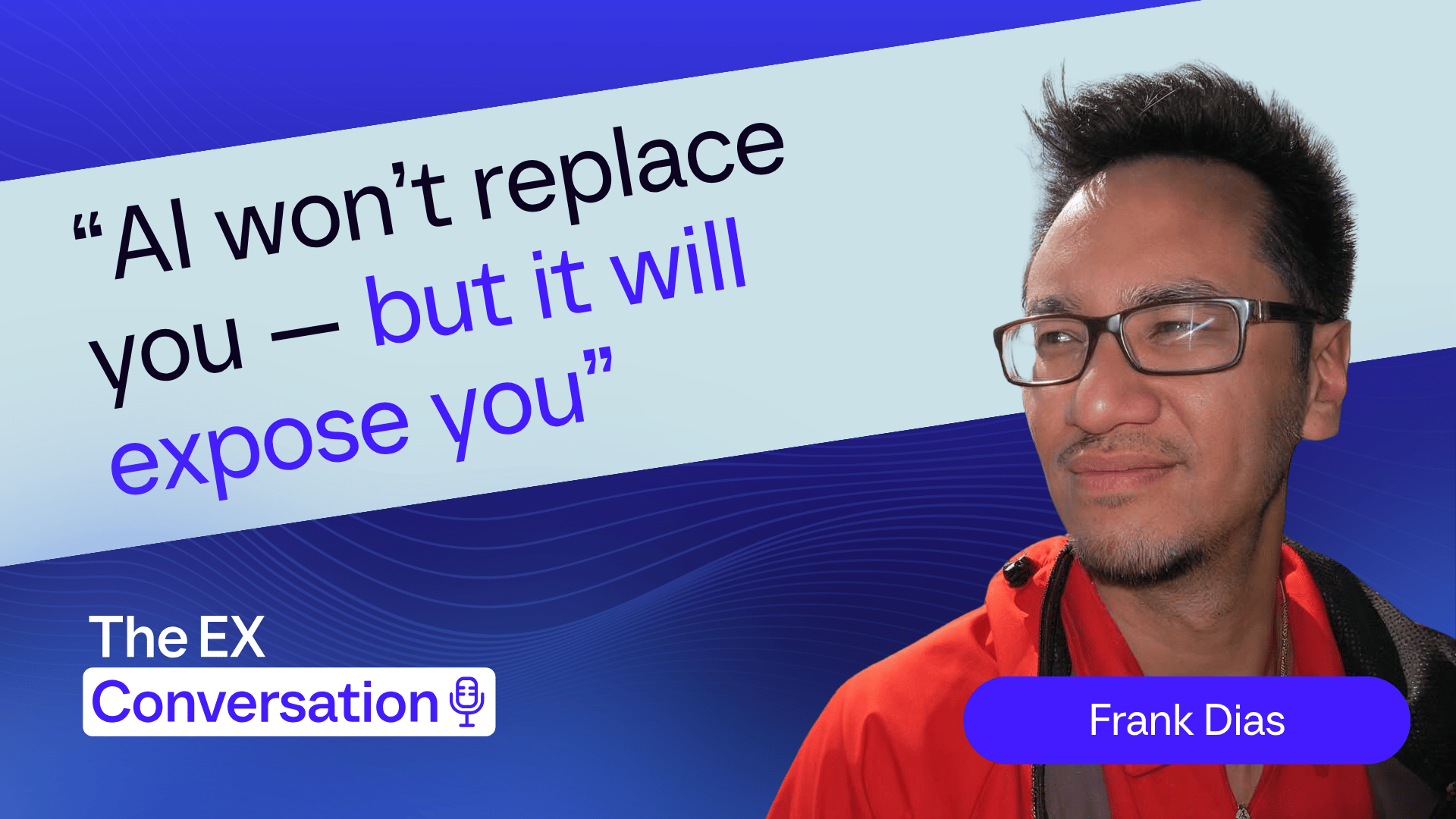
In a recent episode of The EX Conversation, Frank Dias - AI Adoption and Change Consultant and former global Internal Comms Leader - offers a clear, grounded perspective. Drawing on both his comms background and his work helping organizations adopt AI, he makes the case that this isn’t about doing the same work faster. It’s about redefining the role entirely.
1. Stop protecting the work. Start redesigning it
Most internal comms teams are still built around production: drafting content, managing channels, keeping information flowing. It’s work that has historically defined the function.
The challenge is that AI is rapidly shrinking the value of that layer.
“All of that is the production layer… this stuff of AI can convert that into a commodity overnight.”
For many teams, that creates tension. Production work has been the anchor—the visible output that proves value. But it’s also been the reason comms teams feel stretched and unable to step into more strategic roles.
Frank’s view is pragmatic. This isn’t about resisting AI or trying to preserve existing ways of working. It’s about being intentional.
“Use AI for… the more time-consuming tasks… which require not much thinking or judgment.”
That requires a more honest assessment of the work itself. Not everything needs human input. But some things absolutely do. The shift is moving from default involvement to deliberate involvement—deciding where comms should apply thinking, and where it shouldn’t.
Teams that get this right won’t just be more efficient. They’ll finally create the space to do the work they’ve always said they want to do.
2. Your value is judgment, not output
If AI can produce content at scale, then output alone stops being a differentiator.
What replaces it is harder to define—but more important.
“The unique selling point of all of us… is not the… intranets… it is actually our judgment.”
This is where many teams are still catching up. There’s a noticeable gap between what AI can generate and what gets published. Content is technically fine, but often generic, safe, or indistinguishable from everything else in the feed.
Frank points to something internal comms has rarely talked about directly: taste.
The ability to know what’s good. What will land. What should be said—and what shouldn’t.
“You really need to hone what it is that is your personal voice… understand that angle.”
That doesn’t happen by default. It requires reflection, iteration, and a better understanding of your own patterns and instincts. Interestingly, AI can support that process—helping communicators analyze their own past work to surface what makes their voice distinct.
Without that effort, the risk is clear. As more teams rely on the same tools, output converges. And when everything starts to sound the same, influence fades.
Episode 18: Why judgment and taste matter in the age of AI with Frank Dias

3. Move closer to decisions, not further away
AI isn’t just changing how content gets created. It’s changing who can create it.
Platforms are becoming easier to use. Leaders are getting closer to the tools. In some cases, the traditional role of comms as an intermediary is being bypassed completely.
Frank frames this shift directly:
“You could say… the CEO just needs to interact with that intranet platform to actually do all of their comms for them.”
That possibility forces a reset. Not in a defensive way—but in how the role is defined going forward.
“It can’t give them that human judgment… that better understanding of how that content will land.”
That’s the opening.
The opportunity for comms is to step out of being a delivery mechanism and into being a true advisor—closer to priorities, decisions, and trade-offs.
“We need to really invert the pyramid that we’ve built.”
In practise, that means spending less time executing requests and more time shaping them. Building stronger relationships with senior stakeholders. Understanding business context deeply enough to challenge, guide, and refine—not just translate.
For teams that lean into this, AI doesn’t reduce their relevance, it sharpens it.
Why this matters
There’s no neat transition plan for this shift. Most EX leaders are navigating it in real time, alongside everything else already on their plate. The pressure to adopt AI sits alongside the reality of day-to-day delivery.
What Frank’s perspective offers is a more useful lens.
Redesign the work instead of protecting it, and time opens up. Invest in judgment and taste, and quality improves even as volume increases. Move closer to decisions, and the role becomes harder to replace, not easier.
It also changes the conversation with leadership. Instead of defending output, comms can articulate value in terms that matter more: clarity, alignment, and better decision-making.
You don’t need perfect data or a finished roadmap to start. But you do need to be clear on what should remain human, and intentional about protecting it.
Want the full conversation?
This is just one slice of the conversation with Frank Dias on The EX Conversation. The full episode goes further into governance, ethics, and how teams can move from individual experimentation to more coordinated ways of working with AI.
If this reframing resonated, it’s worth spending time with the full discussion—it adds useful nuance to what this shift really looks like in practice.
Get started. Get your personalized demo.