
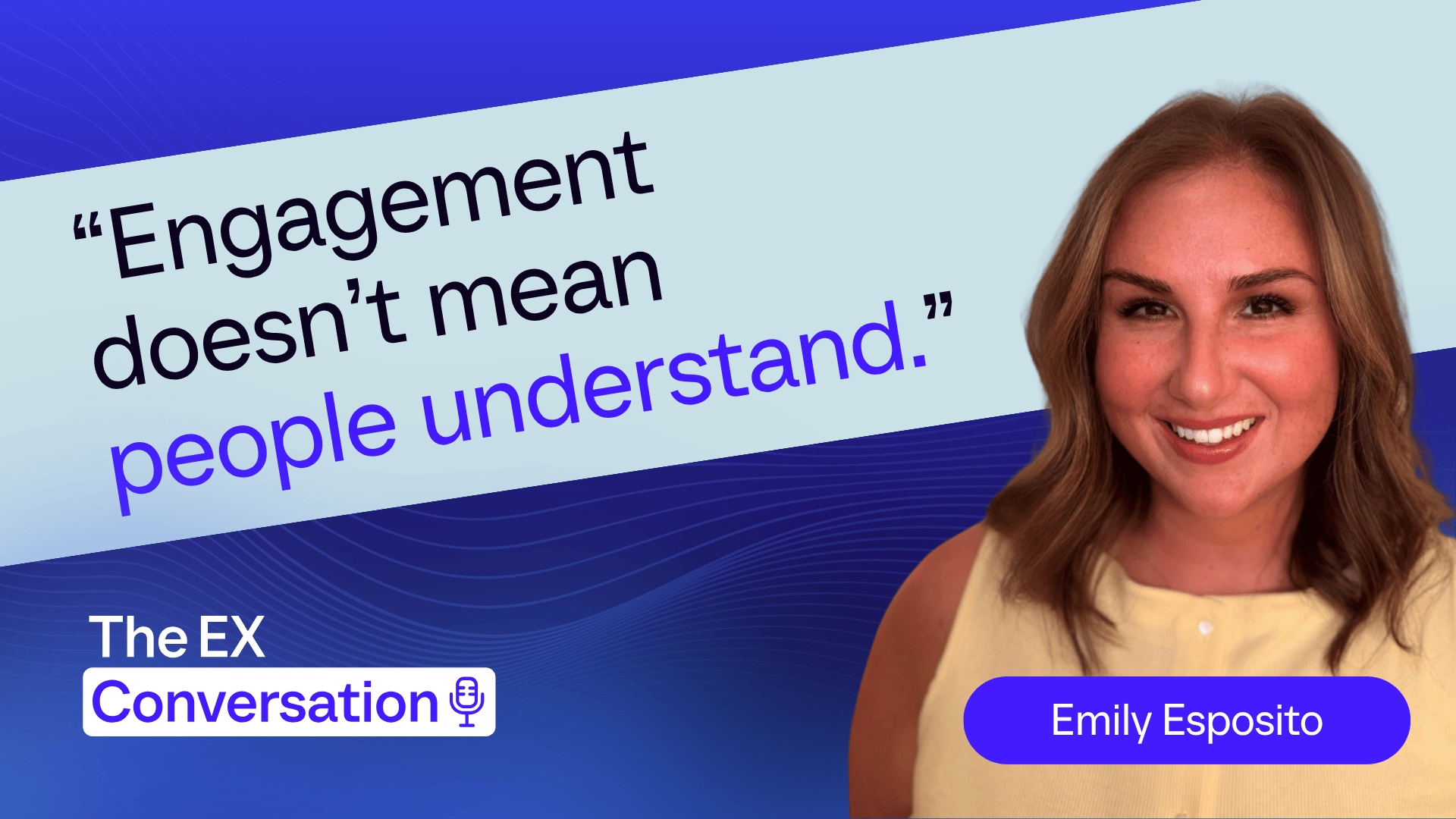
In a recent episode of The EX Conversation, Emily Esposito (Senior Sales Communications and Events Specialist at Boston Beer Company), shares a grounded view from inside a fast-moving, frontline-heavy organization. Having moved from sales into internal communications, her perspective is anchored in what employees actually need to do their jobs, not just what communicators want to say.
Here are three takeaways that stand out.
1. More communication doesn’t create clarity
EX teams often respond to complexity by increasing volume—more updates, more repetition, more channels. But that doesn’t always translate into better understanding.
Emily puts it directly:
“Over-communication does not equal clarity.”
This tension is familiar. Communicators spend weeks building messaging that makes sense internally. But employees—especially those on the frontline—don’t consume it the same way. They’re reading on the move, between tasks, or alongside competing priorities.
Emily’s approach is simple but disciplined: start with the outcome. What does this person actually need to understand and do?
In practice, that means stripping communication back to what’s actionable. At Boston Beer, the same initiative is communicated differently depending on the audience—high-level storytelling for the broader organization, and clear, practical steps for sales teams who need to execute in market.
Clarity comes from relevance and specificity, not repetition.
2. Engagement metrics don’t tell you what you think they do
High engagement is easy to mistake for success. Views, clicks, and adoption rates create a sense of momentum—but they don’t guarantee that people understand or act on what they’re seeing.
Emily is cautious about over-relying on those signals:
“Engagement… doesn’t always equal understanding or happiness.”
This shows up clearly in how her team measures success. Instead of stopping at usage metrics, they look for evidence of execution—whether employees are actually applying what’s been communicated in real-world scenarios.
For example, when teams run campaigns or programs, they track how those show up in the field:
“If it’s fitting in line with what was being presented, then we can see that they were able to absorb the information in the right way.”
That shifts the focus from activity to outcome. It also creates a more honest feedback loop. When something doesn’t land, it becomes visible quickly—through questions, gaps, or inconsistent execution.
In practice, this means EX leaders need to look beyond dashboards. Comprehension—and what follows from it—is the real measure that matters.
Episode 17: Why clarity beats volume in internal comms with Emily Esposito

3. Adoption isn’t driven by tools—it’s driven by people
When organizations struggle with intranet or platform adoption, the instinct is often to focus on features or usability. Emily’s experience suggests something else matters more: behavior—especially from leadership.
Reflecting on the rollout of BrewHub, Boston Beer’s internal platform, she highlights the importance of visibility from the top:
“You have to have that top-down buy-in… we wanted our leadership team to speak about it… and that’ll trickle down.”
But what made the difference wasn’t just endorsement—it was how that endorsement showed up. Leaders stepped outside their usual roles, including taking part in a deliberately light, even vulnerable launch campaign.
“Seeing those leadership members kind of outside of their element… really grabbed everyone’s attention.”
That approach helped cut through in a way traditional comms wouldn’t. It also signaled that the platform—and the behaviors around it—mattered.
Combined with hands-on onboarding and continuous reinforcement, this created momentum where previous attempts had struggled.
In practice, this reinforces a familiar truth: people follow people, not platforms. Adoption is a social challenge before it’s a technical one.
Why this matters
What connects these three ideas is a shift in focus—from how much we communicate, to how effectively people can use what they’ve been given.
For EX leaders, that means being more intentional about what gets shared and how. Not everything needs to be communicated widely or repeatedly. But what is communicated needs to be clear, relevant, and immediately usable.
It also means challenging how success is defined. Engagement metrics are helpful, but they’re incomplete. Real progress shows up in behavior—how consistently people execute, how confidently they make decisions, and how quickly they can act.
And finally, it reinforces that culture and adoption are human problems. Tools play a role, but they don’t drive change on their own. That requires visible leadership, consistent reinforcement, and a willingness to meet employees where they are.
In fast-moving environments, that combination is what allows organizations to move forward without losing clarity along the way.
Want the full conversation?
This conversation from The EX Conversation highlights a perspective that feels increasingly relevant as organizations balance speed with complexity.
If this resonated, it’s worth going deeper into the full episode to explore how these ideas play out in practice, particularly around frontline communication, intranet adoption, and making clarity stick in real-world conditions.
Get started. Get your personalized demo.