
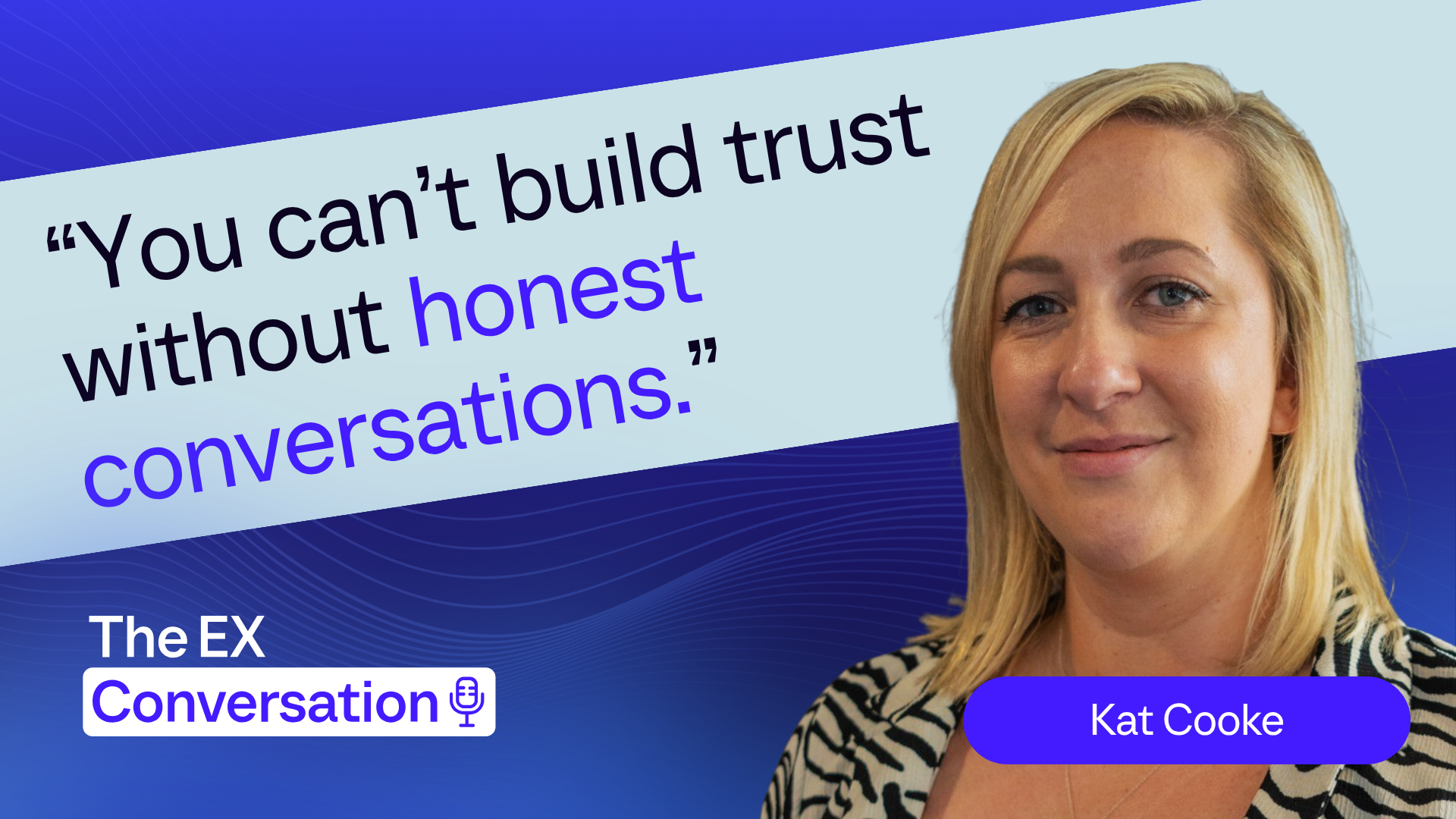
In this episode of The EX Conversation, Kat Cooke, Head of Internal Communications at SCC, shares a grounded view of what it takes to build a culture of trust, transparency, and connection inside a large organization. Drawing on her background in journalism and her experience shaping internal comms strategy, her perspective cuts through a lot of the theory and gets close to the reality of doing this work day to day.
What emerges isn’t a polished framework — it’s a set of trade-offs. And a reminder that trust isn’t built through control, but through consistency, openness, and occasionally discomfort.
1. You can’t have “open comms” without accepting difficult conversations
Most organizations say they value transparency. Far fewer are comfortable with what actually comes with it.
As Kat Cooke puts it: “You might put information out there… it might receive some negative feedback. But that’s not a reason to shy away from it.”
This is the tension many EX and internal comms leaders navigate. It’s relatively easy to design channels that allow feedback. It’s much harder to create an environment where people feel safe using them — especially when the feedback won’t be positive.
Kat’s approach at SCC leans into that reality rather than avoiding it. Anonymous question channels to the CEO. Live Q&A formats where questions aren’t pre-screened. A deliberate effort to respond, rather than deflect.
The intent isn’t just to collect feedback — it’s to normalize it. “It’s about having a conversation… inviting them to give their thoughts and opinions back.”
For EX leaders, the takeaway here is less about the mechanics and more about the mindset. If you design for positivity, you’ll get silence. If you design for honesty, you have to be prepared for discomfort — and show you can handle it.
2. Authenticity isn’t a message — it’s something people need to see
“Be more authentic” is one of the most overused — and under-delivered — ideas in internal comms.
Kat’s point is that authenticity isn’t something you declare. It’s something people notice in the gaps: hesitation, imperfect answers, unscripted moments.
Reflecting on SCC’s shift away from highly staged town halls, she shares: “Our CEO had no idea what kind of questions I was going to ask… people said they could really tell it hadn’t been rehearsed.”
That detail matters. Not because it’s dramatic — but because it signals something rare: leadership willing to be slightly uncomfortable in front of their employees.
In practice, that’s meant moving away from polished presentations toward conversations, with Kat positioning herself deliberately as a representative of the workforce.
“I try and place myself there as being representative of our people… I want them to feel like I’ll go and get answers for them.”
This “internal journalist” mindset reframes the role of internal comms. Not as a channel for leadership messaging, but as a bridge — one that requires credibility on both sides.
For EX leaders, this is where many well-intentioned strategies fall down. Authenticity doesn’t come from tone of voice or branding. It comes from behavior — especially when the stakes are higher.
Episode 15: Building trust through honest conversations with Kat Cooke

3. “Family culture” isn’t about harmony — it’s about trust through realism
Few workplace phrases are as debated as “we’re like a family.” For some, it signals belonging. For others, it raises red flags around blurred boundaries.
Kat’s take is more nuanced — and more realistic: “Family isn’t always sunshine and rainbows… sometimes you don’t get on… but you’ve still got each other’s back.”
This reframing matters. It acknowledges something many organizations try to smooth over: disagreement, friction, and misalignment are normal — and not inherently negative.
At SCC, that sense of “family” shows up less as constant harmony and more as long-term commitment and mutual support. People stay. They return. They recommend the workplace to others.
“People don’t choose to have their career somewhere lightly… it’s testament to the environment.”
For EX leaders, the implication is subtle but important. Culture isn’t built by eliminating tension — it’s built by creating conditions where tension doesn’t break trust.
And that links back to transparency. If people feel they can disagree, challenge, and still belong, you’re closer to a resilient culture than one that simply avoids conflict.
Why this matters
There’s a tendency in EX to look for scalable solutions — frameworks, platforms, playbooks that can be rolled out consistently across the organization.
What this conversation highlights is that some of the most important shifts aren’t scalable in the same way. They’re behavioral. Cultural. And often led by example rather than design.
Choosing to open up difficult conversations means accepting unpredictability. Moving toward authentic leadership communication means giving up some control. Embracing a “family-like” culture means tolerating friction without letting it damage trust.
None of these are easy. And none of them come with guaranteed outcomes.
But they do move EX leaders closer to something more durable: credibility. The kind that makes employees more likely to engage, speak up, and believe what they’re being told — even when the message is hard.
And in an environment where trust is increasingly fragile, that credibility is what enables progress — even without perfect conditions.
Want the full conversation?
This episode of The EX Conversation surfaces something many EX and internal comms leaders already feel: that the real work isn’t just improving communication — it’s reshaping the relationship between employees and leadership.
If this perspective resonates, it’s worth listening to the full episode for a deeper look at how these ideas play out in practice, from building trust in real time to balancing authenticity with organizational realities.
Get started. Get your personalized demo.