
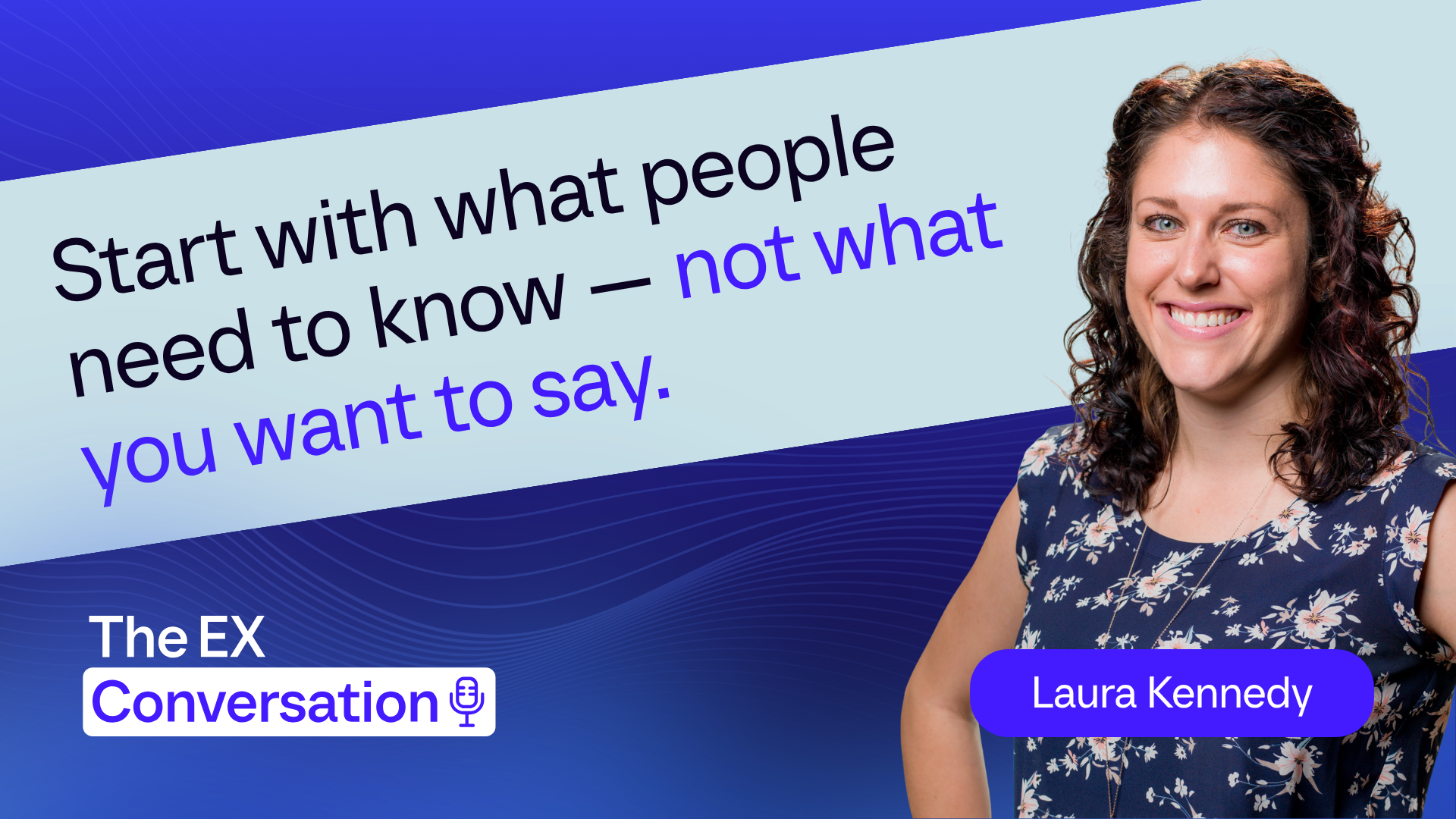
In a recent episode of The EX Conversation, Laura Kennedy, Director of Team Member Communications at Life Time, shares a practical view of what it takes to make communication work across that full spectrum. Drawing on her background in journalism and experience in a complex, frontline-heavy organization, she offers a grounded perspective on what actually moves the needle.
What emerges isn’t a new framework or model — it’s a clearer way of thinking about relevance, scale, and how communication really flows inside organizations.
1. Relevance matters more than reach
One of the most common habits in internal communication is defaulting to “send to everyone.” It feels inclusive. It feels safe. But in practice, it creates noise.
The reality most EX leaders recognize is that employees — especially on the frontline — don’t have time to filter what matters from what doesn’t. When everything is sent to everyone, attention drops and trust erodes.
Laura describes a different approach:
“Relevance has never been more important… being able to create those audience segments for any particular message, it helps to build some trust with the team that if our team is sending something, it is important.”
At Life Time, where many employees are non-desk and time-poor, communication has to earn attention quickly. That means being deliberate about who needs to know what, and being comfortable not including everyone.
This is less about segmentation as a tactic and more about mindset. It requires:
- Clarity on who needs to act versus who just needs awareness
- Discipline to avoid over-communicating “just in case”
- Respect for employees’ time and attention
When relevance improves, engagement tends to follow, not because messages are more polished, but because they feel worth reading.
2. Managers are the channel — whether you plan for it or not
Most organizations already rely on managers to communicate. The difference is whether that reliance is intentional.
EX teams often invest heavily in crafting clear, well-written messages — but those messages don’t always land at the team level. The missing piece is reinforcement.
Laura puts it simply:
“If their leader isn’t reinforcing the importance of that ask or of that message, a lot of times it does fall flat.”
At scale, internal comms teams can’t tailor every message to every role, location, or context. Managers can. They understand their teams, their priorities, and how to translate information into something meaningful locally.
What’s often overlooked is how little support managers get to do this well.
“We’re putting a big burden on people to deliver the most important communications… and not necessarily setting them up for success on how to do that.”
At Life Time, this has led to a more structured approach:
- Providing talking points and context, not just announcements
- Bringing managers in early so they’re not reacting in real time
- Building communication capability before people step into leadership roles
The takeaway isn’t just that managers matter. It’s that treating them as a core channel requires investment, structure, and consistency — not assumption.
Episode 10: Leveling up communication across the workforce: Leaders, managers & frontline with Laura Kennedy

3. Clarity beats completeness
A common instinct in internal communication is to explain everything — the background, the rationale, the full picture. It’s well-intentioned, but it often works against how people actually consume information.
Laura’s journalism background brings a different lens:
“You should be starting with the bottom line… what’s the one thing that you really, really need to know.”
For employees with limited time — particularly on the frontline — clarity is more valuable than completeness. If the key message isn’t immediately obvious, it’s easy to miss entirely.
This also shows up in how messages are written. Laura is direct about the need to move away from overly formal, jargon-heavy language:
“We are human beings speaking to other human beings.”
Clear, conversational communication doesn’t reduce professionalism. It reduces friction. It helps people understand what matters and what to do next, quickly.
The shift here is subtle but important: from sharing everything → to making the most important thing clear.
Why this matters
Communicating effectively across leaders, managers, and frontline teams isn’t about finding a single solution. It’s about recognizing that different parts of the workforce experience communication differently — and designing accordingly.
What Laura’s perspective highlights is a set of practical shifts:
- Prioritizing relevance over reach
- Treating managers as a deliberate communication channel
- Focusing on clarity instead of completeness
These aren’t new ideas. But applying them consistently — especially in complex organizations — is where the real challenge lies.
For EX leaders, this way of thinking makes it easier to move forward without perfect systems or unlimited capacity. It anchors decisions in what actually helps people understand, trust, and act.
Want the full conversation?
This is just one perspective from a broader conversation with Laura Kennedy on The EX Conversation.
If this resonated, it’s worth spending time with the full episode. There’s more depth on manager enablement, digital workplace friction, and how communication connects to the wider employee experience — especially in frontline environments.
Get started. Get your personalized demo.