

Employees are not short of information. They are surrounded by it. Every day brings another update, another priority, another system notification, another leadership message, another piece of content asking for attention.
In this environment, reach isn’t the same as engagement. A message delivered isn’t automatically a message absorbed. Better, well-crafted content helps it land, but even the clearest message doesn’t guarantee participation. People can read something, agree with it, and still stay passive.
Broadcast still matters. In complex organizations, there are moments when leaders need to communicate with clarity, consistency, and control. A merger announcement, a crisis update, a policy change, or a strategic decision often needs to land before it can be opened up.
On its own, though, broadcast has limits. It creates awareness and consistency, but the shared understanding, trust, and momentum people need often develop after the message has landed.
That is where community becomes essential: not as a replacement for broadcast, but as what happens next. It gives people space to respond, contribute, share, challenge, recognize, learn, and belong.
The Hidden Cost of One-Way Communication
One-way communication becomes a problem when organizations expect it to deliver outcomes it was never designed for. Broadcast is strong on consistency, but weaker at surfacing questions, local context, resistance, uncertainty, or the informal knowledge employees use to make sense of change.
Knowledge becomes harder to find and easier to lose. Expertise sits with individuals instead of becoming shared value. Culture becomes something leaders describe, rather than something employees experience together.
The risk grows as organizations scale, distribute, acquire, and transform. In moments of merger, change, or rapid innovation, the first message may need control, but the work that follows needs participation. People need more than a statement about the future. They need a way to understand it, question it, and see their place in it.
CVS Health is a clear example. After one of the largest healthcare mergers in US history, the organization needed to bring 300,000 employees together across two legacy intranets and align people around one shared purpose. The challenge was not simply publishing more information. It was rebuilding connection at scale.
From Audience to Community
The difference between an audience and a community is participation.
Audiences receive information. Communities add something back: context, questions, experience, recognition, challenge, and collective understanding.
The shift is not from broadcast to community as if one replaces the other; It is from communication that ends at delivery to communication that continues through participation. When employees move from audience to participants, they connect around what matters to them: their role, location, expertise, networks, interests, and shared goals.
The organization gains access to knowledge that broadcast can never fully reach. Employees gain a stronger sense that they are not just being informed about the business. They are part of it.
Over time, that participation builds stronger connections between people. Those connections create belonging, and belonging gives culture, knowledge sharing, and organizational momentum a more durable foundation.
That is why the goal should not be to turn every communication into a conversation. It should be to know when a message needs control, when it needs contribution, and how to turn the right content into momentum.
Why Participation Needs Design
Open communities are not automatically healthy communities. Left unmanaged, they can create new problems: moderation burden, toxic threads, duplicated questions, information overload, misinformation, or spaces where a vocal few dominate while others stay silent.
That is why many employee experience leaders are cautious about opening up comment culture. Their concern is not usually participation itself. It is participation without purpose, ownership, norms, or governance.
Avoiding dialogue altogether leaves valuable understanding on the table. The better answer is to design for it carefully, with a clear reason for each community to exist, visible sponsorship, active moderation, and shared norms for useful participation.
Not every update needs a comment thread. Not every topic needs a community. But the moments that require sense-making, peer learning, feedback, or shared momentum need more than a broadcast channel. They need participation that is intentional, governed, and connected to outcomes.
What Leading Organizations Do Differently
The organizations making the strongest progress are not treating social participation as a side channel. They are connecting it to strategic priorities, leadership alignment, employee voice, and measurable outcomes.
Dentsu: Communities as an Innovation Engine
At dentsu, communities are helping turn strategy into everyday action. The company’s Unily-powered employee experience platform connects 68,000 employees across 120 countries, giving people a consistent global experience that still feels local. Communities such as AI Connective bring thousands of employees together around emerging technology, learning, and innovation.
The lesson is clear. Communities create the most value when they are tied to business priorities and supported by leadership. In that environment, strategic intent becomes something employees can interpret, build on, and put into action together.
Alshaya: Every Employee Gets a Voice
For Alshaya, participation has helped close the gap between corporate teams and a large frontline workforce. With more than 50,000 employees across brands, borders, stores, and offices, the business needed a way to reach people who were not always served by email or traditional portals.
Through a mobile-first employee experience, Alshaya has given employees access to communications, stories, resources, and social spaces in one place. The impact includes a 30% increase in employee engagement and a 90% response rate on engagement surveys.
The lesson is that participation is an equalizer. It gives every employee a way to be heard, including the frontline workers that broadcast channels often miss.
CVS Health: Dialogue at Scale
CVS Health shows what participation can do in a large, complex organization. By creating a more connected digital employee experience, the business gave hundreds of thousands of employees a clearer place to engage, contribute, and align around shared purpose.
CVS Health lifted more than content consumption. Comments rose by 85% and adoption reached 90% in year one. At enterprise scale, dialogue becomes a practical mechanism for reconnecting fragmented cultures.
Communities as Infrastructure, Not a Feature
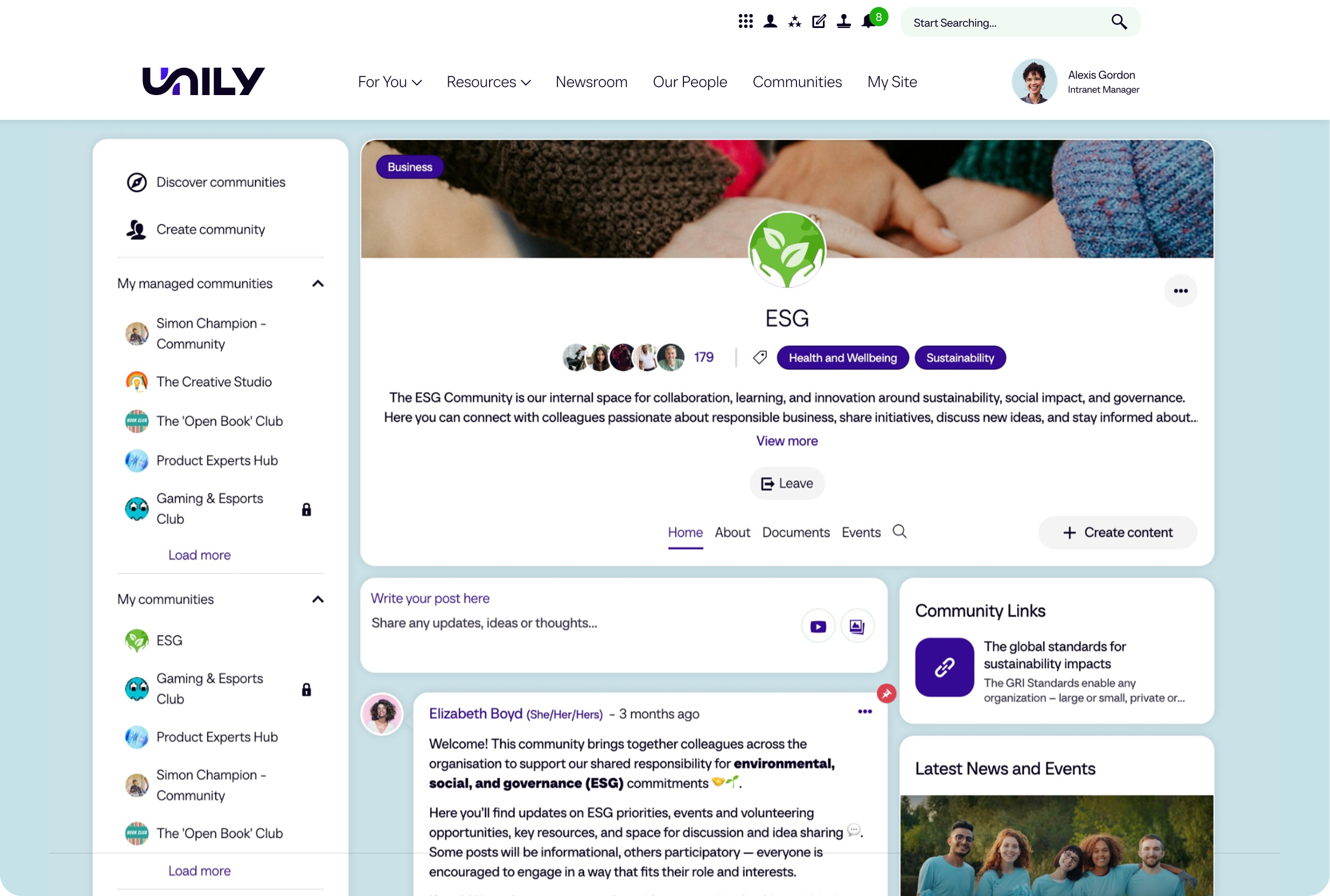
The common thread across these examples is not the existence of social tools. It is the decision to treat participation as part of the employee experience infrastructure.
When they are governed, sponsored, and tied to outcomes, communities become the connective layer between people, knowledge, culture, and strategy. They help leaders strengthen alignment while surfacing knowledge that already exists inside the business.
That changes the questions leaders ask. Instead of starting with “What should we post?” they start with “Where do our people take part?” Instead of measuring only distribution, they look for signs of response, contribution, connection, and momentum.
The Future Is Participation
The future of employee experience depends on connecting broadcast with participation. Leaders need the ability to communicate clearly when clarity matters, then create space for people to engage when understanding, trust, and action matter more.
For leaders, that means moving beyond managing the flow of messages. It means designing the conditions for connection. It means giving employees places to share what they know, find people who understand their context, and feel part of the direction the organization is moving in.
The strongest organizations know when to communicate with authority and when to invite contribution. They use broadcast to provide direction, then use community to make that direction meaningful, practical, and shared.